How to Predict Competitor Ad Spend & Channel Mix with AI Models
AI ad intelligence tools can now estimate competitor ad spend within 10–15% accuracy, identify their top-performing creatives, and map their channel mix across Google, Meta, TikTok, and programmatic networks — all without access to their internal dashboards. For small business owners running paid media, this capability levels the playing field against larger competitors who once held an information monopoly.
This guide walks you through the exact process: which AI tools to use, what signals they analyze, and how to turn competitive intelligence into smarter budget decisions for your own campaigns.
Why Competitor Ad Intelligence Matters More in 2026
Ad costs have risen sharply across every major platform. Google Search CPCs in competitive retail categories now average $3–$8, and Meta CPMs in the U.S. regularly exceed $14. In that environment, wasting budget on channels your competitors have already tested and abandoned is an expensive mistake.
AI-powered competitor analysis solves this by doing three things simultaneously:
- Estimating how much a competitor spends per channel based on ad frequency, impression share proxies, and creative volume
- Identifying which ad formats and messages generate engagement vs. which get paused quickly
- Detecting channel mix shifts — for example, when a competitor pulls back from Google Shopping and doubles down on Meta Reels
When you know those three things, you stop guessing and start allocating budget strategically.
The 4 Data Signals AI Models Use to Estimate Ad Spend
No external tool has access to a competitor's actual invoices. Instead, AI models triangulate spend from observable signals:
- Ad library frequency: Meta's Ad Library and Google's Ads Transparency Center show how long ads have been running. Longer runtimes at high creative volume signal higher spend.
- Impression share modeling: Tools like Semrush, SpyFu, and SimilarWeb use panel data and search volume to reverse-engineer estimated impression share and monthly spend ranges.
- Creative velocity: Brands spending heavily on paid media rotate creatives every 7–14 days. A competitor publishing 20+ active ad variants simultaneously signals a $50K+/month budget.
- Landing page traffic patterns: Traffic estimation tools (SimilarWeb, Ahrefs) show spikes in direct and referral traffic that correlate with campaign launches.
Modern AI platforms layer these signals together using machine learning models trained on verified ad spend data from brands who have opted into benchmarking panels, producing spend estimates that are directionally reliable even when not exact.
Top AI Tools for Competitor Ad Creative Analysis
Here is a structured comparison of the leading platforms for AI PPC competitor analysis in 2026:
Tool Best For Key AI Feature Channels Covered Semrush Advertising Toolkit Google Search & Shopping Ad copy trend clustering Google, Bing Meta Ad Library + third-party AI parsers Social creative analysis Creative performance scoring Facebook, Instagram Pathmatics (by Sensor Tower) Cross-channel spend estimation Channel mix prediction model Display, social, video, mobile Foreplay.co Creative intelligence for social AI creative scoring & swipe files Meta, TikTok SpyFu Budget & keyword history Historical spend trend graphing Google SearchHow to Deconstruct a Competitor's Channel Mix
Channel mix analysis answers the question: where is your competitor concentrating their ad budget? Follow this four-step process:
- Run a domain report in Pathmatics or SimilarWeb: Pull your competitor's domain and filter for paid channels. Look at the percentage split between search, social, display, and video over the last 90 days.
- Check Google Ads Transparency Center: Search your competitor's brand name. Count active search and Shopping ads. More than 10 active Shopping ads signals a significant Google Shopping investment.
- Audit their Meta Ad Library: Filter by country and ad type. A brand running 30+ active ads with video-heavy creatives is prioritizing Meta over search.
- Feed data into an AI summarization tool: Export what you find and use a large language model (GPT-4o, Claude 3.5, or Gemini 1.5 Pro) to identify patterns, flag anomalies, and generate a written channel mix summary you can share with your team.
This process takes under two hours and produces a channel map that would have required a dedicated analyst in 2020.
Analyzing Competitor Ad Creative with AI
Spend data tells you how much a competitor is investing. Creative analysis tells you what's working for them. Here is how to apply AI to competitor ad creative analysis effectively:
- Identify long-running ads: Any ad running for 30+ days in Meta's Ad Library is almost certainly profitable. These are the creatives worth studying most carefully.
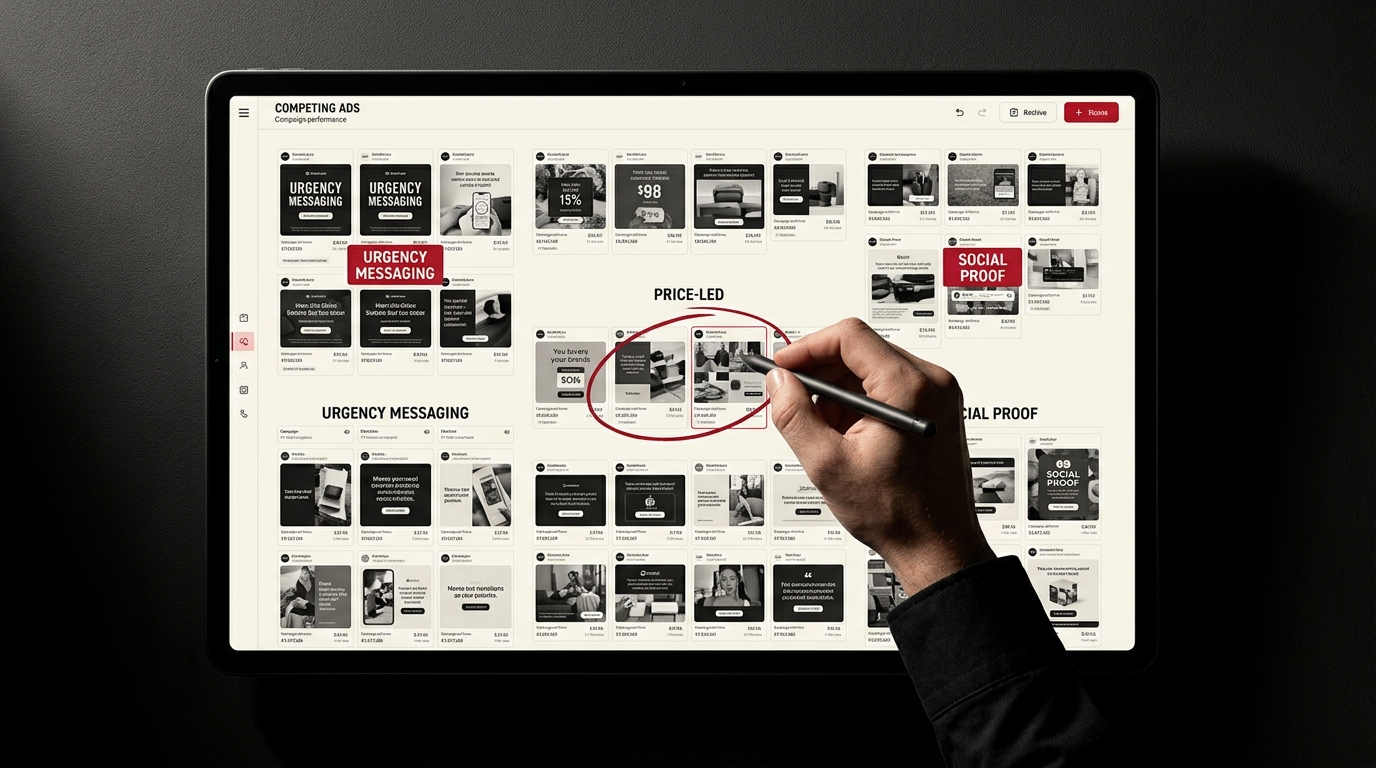
- Extract messaging themes: Copy 10–20 competitor ad headlines and body texts into a language model. Prompt it to group them by messaging theme — price-based, emotion-based, urgency-based, or social-proof-based.
- Score visual formats: Tools like Foreplay and Motion.app analyze whether static images, carousels, or video ads dominate a competitor's active library, and they score creative elements like hooks, CTAs, and offer positioning.
- Track creative refresh cadence: If a competitor swaps creatives every week, they're likely running aggressive A/B tests. If their ads stay static for 60+ days, they've likely found a control creative and are scaling it.
For Shopify, BigCommerce, and WooCommerce store owners in particular, creative analysis is where the biggest ROI gains live. Understanding that a competitor is scaling a UGC video ad with a "free shipping" hook, for example, tells you exactly what offer and format to test against them.
Turning Competitive Intelligence into Budget Decisions
Intelligence is only valuable when it changes your actions. Use what you find to make three specific decisions:
- Find underinvested channels: If every competitor is heavy on Meta but light on Google Shopping or YouTube, those channels represent lower competition and potentially lower CPCs for you.
- Match or outpace creative quality in your category: If competitors are running high-production video ads and you're running static graphics, you're already behind on platforms that reward engagement.
- Set realistic budget benchmarks: If your primary competitor spends an estimated $80K/month across channels and you're spending $5K, you need either a much tighter niche focus or a dramatically different channel strategy — not just more spend.
Limitations to Keep in Mind
AI ad intelligence is powerful but not perfect. Spend estimates carry a margin of error of 15–25% for smaller brands with limited public data signals. Creative performance scores from third-party tools reflect engagement proxies, not actual conversion rates. Always treat AI-generated competitive data as directional input, not ground truth, and validate key assumptions against your own campaign performance data.
What is AI ad intelligence?
AI ad intelligence refers to using machine learning models and large-scale data aggregation to estimate competitor advertising spend, identify active ad creatives, map channel mix, and detect messaging strategies — without access to a competitor's internal ad account. Tools like Pathmatics, Semrush, and SpyFu are leading examples in 2026.
How accurate are AI competitor ad spend estimates?
Leading AI tools estimate competitor ad spend within 10–25% accuracy for brands with significant public ad footprints (large creative libraries, long-running campaigns). Accuracy decreases for smaller brands or those relying heavily on non-indexed programmatic channels. Use spend estimates as directional benchmarks, not exact figures.
Which tool is best for competitor ad creative analysis on Meta?
Meta's own Ad Library provides the raw data. Pair it with a dedicated AI creative intelligence tool like Foreplay.co or Motion.app to score creatives, identify long-running (likely profitable) ads, and analyze messaging hooks at scale. This combination is more effective than using either resource alone.
Can small ecommerce stores realistically use AI PPC competitor analysis?
Yes. Tools like SpyFu and Semrush start at accessible monthly price points, and the free tiers of Meta Ad Library and Google Ads Transparency Center provide substantial creative intelligence at no cost. A Shopify or WooCommerce store owner can run a meaningful competitor audit in two to three hours using only free tools.
How often should I run a competitor ad intelligence audit?
Run a full channel mix and creative audit quarterly. Monitor Meta Ad Library and Google Ads Transparency Center monthly for major creative shifts or new offer angles. During peak retail seasons — Q4, back-to-school, major sales events — increase monitoring to weekly so you can respond to competitor promotions in near real time.