The 2026 Framework for AI Search Competitor Analysis
AI search competitor analysis is the practice of identifying which brands appear as cited sources, named recommendations, or authoritative references inside AI-generated answers — and using that data to close your own visibility gaps. In 2026, ranking on page one of a traditional SERP is no longer sufficient. Platforms like Google AI Overviews, Perplexity, ChatGPT Search, and Microsoft Copilot now answer buyer questions directly, and the competitors cited inside those answers are capturing intent that never reaches a blue-link result.
If you run a small ecommerce business on Shopify, WooCommerce, or BigCommerce, this shift changes how you study your competitive landscape. Here is a structured framework for doing it right.
Why Traditional Competitor Analysis Falls Short in AI Search
Classic SEO competitive research measures keyword rankings, domain authority, and backlink counts. Those signals still matter, but AI search engines weight a different set of factors when deciding which brands to surface inside a generated answer:
- Entity authority: How consistently is your brand mentioned across trusted third-party sources — review sites, trade publications, industry directories?
- Structured data quality: Do your product pages use Schema.org markup that AI crawlers can parse unambiguously?
- Topical depth: Does your site answer the full arc of a buyer's question, or only the transactional tail?
- Citation recency: AI models favor sources updated frequently. A blog last touched in 2023 is a liability in 2026.
A competitor ranking #8 organically can appear in every AI Overview for high-intent queries simply because their content architecture aligns with how generative models retrieve and validate information. That is the gap your analysis must expose.
Step 1 — Map the AI Citation Landscape for Your Category
Start your AI citation gap analysis by running 30–50 representative queries across at least three AI platforms: Google AI Overviews, Perplexity Pro, and ChatGPT Search. Use queries that reflect real buyer language at every funnel stage — awareness, comparison, and purchase.
For each query, record:
- Which brand names appear inside the generated answer (not just cited links)
- Which URLs are cited as sources in footnotes or references
- The framing used — is a competitor called "best," "most affordable," or "trusted by"?
- Whether your brand appears at all
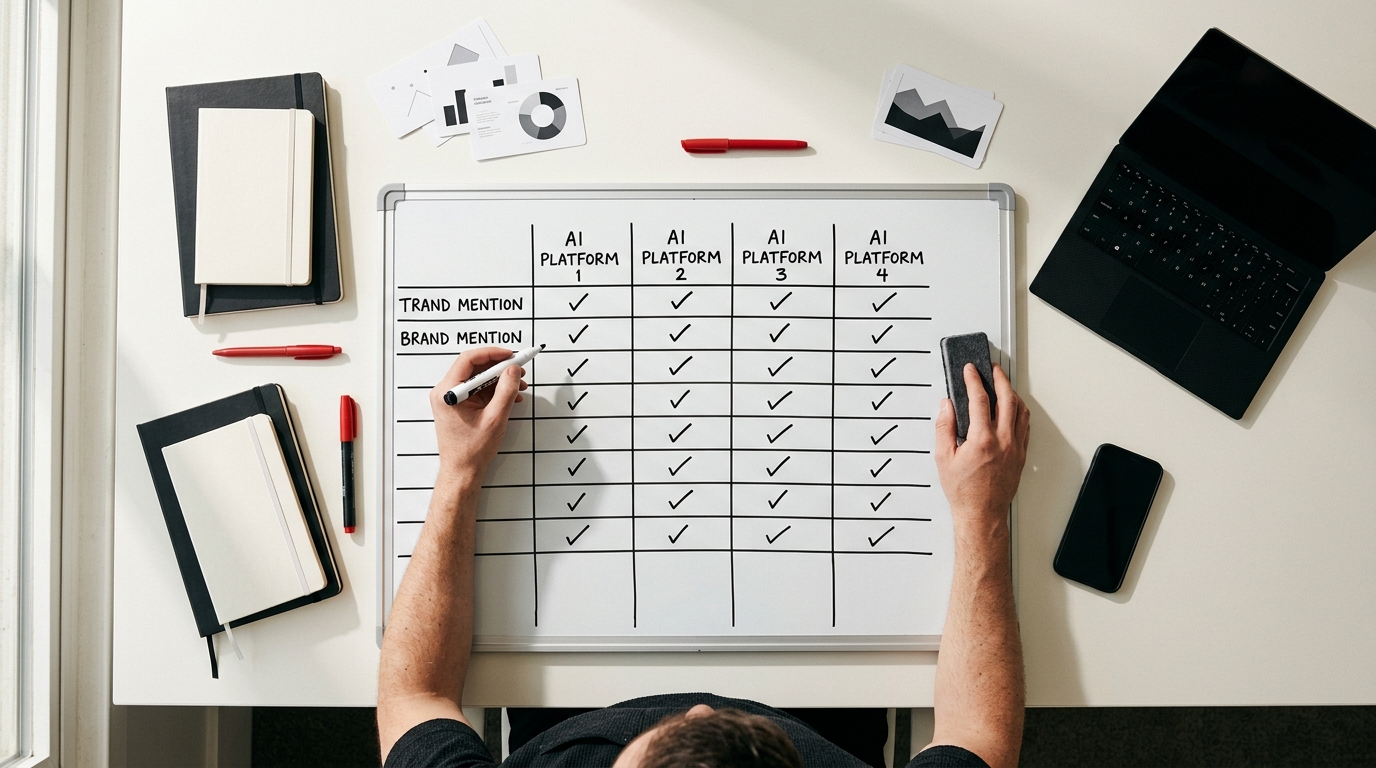
Build a simple spreadsheet with queries as rows and competitors as columns. Mark each cell where a competitor is cited. After 50 queries, clear patterns emerge: two or three competitors will dominate AI citations while others — including, likely, you — appear rarely or never.
Step 2 — Competitor GEO Strategy Reverse-Engineering
GEO (Generative Engine Optimization) is the discipline of optimizing content specifically for AI retrieval. Your competitors who consistently appear in AI answers are running a GEO strategy, whether they call it that or not. Reverse-engineer it by auditing the pages that get cited most often.
Look for these patterns in cited competitor content:
- Definitive answer formatting: The page opens with a direct, one-sentence answer before expanding. AI models extract these as citations because they are easy to quote.
- FAQ schema: Pages using
FAQPageSchema markup appear in AI answers at a disproportionate rate because the question-answer structure mirrors how generative models respond. - Named statistics with sources: Competitors who cite specific numbers (with attribution) are treated as more authoritative by retrieval systems.
- Comparison tables: Structured data in table format is machine-readable and frequently pulled into AI-generated comparisons.
- Author expertise signals: Bylines linked to author pages with credentials, social profiles, and publication history improve entity trust scores.
AI Search vs. Traditional SERP: 5 Key Differences for Competitor Analysis
Factor Traditional SERP Analysis AI Search Competitor Analysis Primary metric Keyword ranking position Citation frequency in AI answers Authority signal Domain Rating / backlink profile Entity mentions across third-party sources Content format Long-form keyword-dense articles Structured, directly answerable content with schema Competitive tool Ahrefs, Semrush keyword gap Manual prompt audits + emerging tools like Profound, Otterly.AI Update frequency Weekly rank tracking Continuous — AI answers shift with model updates and new training dataStep 3 — Track Competitor AI Visibility Over Time
To track competitor AI visibility systematically, you need a repeatable process because AI-generated answers are not static. Model updates, new competitor content, and shifts in third-party mentions all change who gets cited.
Set up a monthly monitoring cadence using this workflow:
- Define a fixed query set of your 30 most commercially valuable questions. Keep this list stable so you can measure change.
- Run queries across platforms and log citations in your tracking spreadsheet. Tools like Profound and Otterly.AI automate portions of this for larger query sets.
- Score citation share — divide the number of times a competitor is cited by the total queries run. A competitor cited in 18 of 30 queries holds a 60% citation share for that topic cluster.
- Tag sentiment framing — note whether citations are positive ("recommended"), neutral ("mentioned"), or comparative ("cheaper alternative to").
- Identify new entrants — brands that appear in AI answers but do not rank in your traditional SERP top 10 are pure AI-native threats.
Step 4 — Close the Gap with a Targeted Content Response
Once you know which competitors dominate AI citations and why, build a prioritized content response. Focus your effort on three areas:
1. Answer the questions your competitors are winning. For every query where a competitor is cited and you are not, create or substantially update a page that opens with a direct answer, uses FAQ schema, and includes at least one data point with a named source.
2. Build your entity footprint. AI models validate brands by cross-referencing them across multiple independent sources. Prioritize getting your business listed and reviewed on G2, Trustpilot, industry publications, and niche directories relevant to your product category. For Shopify merchants, this includes the Shopify App Store partner ecosystem and product review aggregators in your vertical.
3. Refresh high-potential pages quarterly. AI retrieval systems de-prioritize stale content. A quarterly refresh — updated statistics, a new FAQ block, revised schema — signals recency and increases the probability of citation.
The Competitor GEO Strategy Scorecard
Use this scorecard to rate each major competitor on their AI search readiness. Score each factor 1–5:
- Direct-answer content formatting (opens with a clear answer)
- FAQ and structured data schema implementation
- Third-party entity mentions (reviews, press, directories)
- Content freshness (updated within 6 months)
- Author expertise and E-E-A-T signals
- Citation frequency across your monitored query set
Any competitor scoring 25 or above out of 30 is a high-priority threat. Any scoring below 15 is a potential opportunity — their traditional organic rankings may not translate into AI visibility, creating a window for you to move ahead in the AI channel first.
Frequently Asked Questions
What is AI citation gap analysis and how is it different from a keyword gap analysis?
AI citation gap analysis identifies which questions, topics, and query types result in your competitors being named or sourced inside AI-generated answers while your brand is absent. Unlike keyword gap analysis — which compares which search terms a competitor ranks for versus you — citation gap analysis focuses on generative answer inclusion, which is determined by content structure, entity authority, and schema quality rather than keyword density alone.
Which tools can I use to track competitor AI visibility in 2026?
The most purpose-built tools for AI visibility tracking include Profound, Otterly.AI, and Brandwatch's AI mention monitoring. For smaller budgets, manual prompt audits across Google AI Overviews, Perplexity, and ChatGPT Search using a fixed query set remain effective when run on a monthly schedule. Traditional SEO platforms like Semrush and Ahrefs have begun adding AI visibility modules, but purpose-built GEO tools provide deeper citation-level data.
How often do AI search citations change for a given topic?
AI-generated answers shift with model updates, new web crawls, and changes in third-party mention patterns. In practice, citation compositions for stable informational queries change moderately month to month, while transactional and comparison queries — "best [product] for [use case]" — can shift more rapidly as competitor content and reviews update. Monthly monitoring is the minimum viable cadence; weekly monitoring is recommended for high-revenue query clusters.
Does traditional SEO work still matter for AI search competitor analysis?
Yes. Strong traditional SEO — technical health, backlink authority, topical coverage — remains a foundation that AI retrieval systems build on. However, a site can have strong traditional SEO metrics and low AI citation rates if its content is not structured for direct-answer extraction. The most competitive brands in 2026 optimize for both: traditional ranking signals and GEO-specific content architecture simultaneously.
How should ecommerce brands on Shopify or WooCommerce approach AI competitor analysis differently than service businesses?
Ecommerce brands face a specific challenge: product pages are transactional and thin on the kind of explanatory content that AI models cite. The fix is a dual-layer strategy — maintaining robust, schema-marked product pages while building supporting content (buying guides, comparison pages, use-case articles) that AI models can cite in research-phase queries. Shopify merchants should also ensure their product structured data uses Product, Review, and Offer schema correctly, as these feed directly into AI shopping answer features.