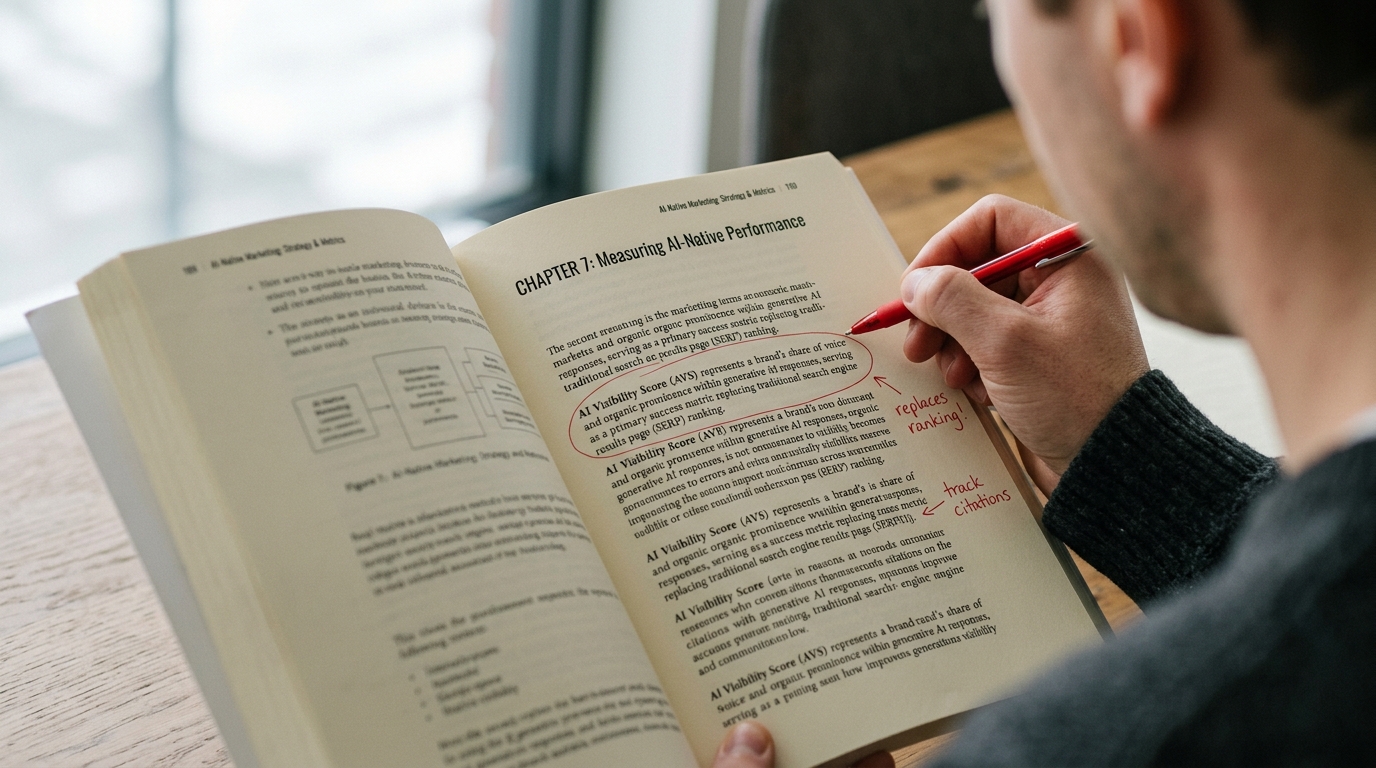
The AI Visibility Score is a composite key performance indicator (KPI) designed to measure a brand's ai search visibility across AI-driven search results, including AI Overviews, chatbot responses, and other generative AI outputs. It replaces outdated metrics like simple keyword rankings by accounting for citations, sentiment, and the context of brand mentions within AI-generated answers.
Why Traditional SEO KPIs Are Failing in 2026
For years, small business owners have relied on a straightforward set of metrics to gauge their search engine optimization (SEO) success: keyword rankings, organic traffic, and backlink counts. If your Shopify store ranked in the top three for "handmade leather wallets," you were winning. However, the rapid integration of Large Language Models (LLMs) into search engines like Google and Bing has fundamentally changed the user experience, making these legacy KPIs dangerously incomplete.
The "ten blue links" are no longer the primary way customers find you. Instead, they get direct answers from AI Overviews (formerly SGE), ask questions to chatbots like Gemini or Perplexity, and receive synthesized recommendations. In In this new landscape, a #1 keyword ranking doesn't guarantee visibility if the AI doesn't cite your business in its generated answer. This shift requires a new way of measuring success that captures your ai search visibility and influence within the AI's knowledge base.ninDefining the AI Visibility Score (AVS) The AI Visibility Score isn't a single number you'll find in Google Search Console (at least, not yet).s a custom, weighted metric that your business or marketing partner must calculate by combining several data points. Think of it less like a single temperature reading and more like a comprehensive health index for your brand in the age of AI search.
A robust AVS is built on three core pillars:
Citation Frequency & Prominence: How often is your brand, product, or content directly cited as a source in AI-generated answers for your target queries? Is it the first source mentioned or the last?
Answer Sentiment & Framing: When the AI mentions your brand, is the context positive, neutral, or negative? Does it frame your product as a premium option, a budget-friendly choice, or the best overall solution?
Share of Answer (SoA): What percentage of the AI-generated answer is influenced by your content? If an AI Overview provides three main points, how many of those points are derived from information on your website?
By tracking these elements, you move beyond "Are we ranking?" to "How is AI portraying our brand to potential customers?"
How to Track and Measure Your AI Visibility Score
Measuring AVS requires a new stack of tools and a more investigative approach than simply logging into an SEO platform. Here's a step-by-step guide to get started.
Step 1: Identify Your Core "Problem & Solution" Queries
Start by brainstorming the questions and problems your customers have, not just the keywords they use. Instead of "BigCommerce SEO," think "how to improve sales on my BigCommerce store?" or "best BigCommerce apps for marketing." These conversational queries are more likely to trigger detailed AI responses.
Step 2: Conduct a Manual AI Citation Audit
Before investing in new tools, perform a manual audit. Use major AI-powered search tools (Google's AI Overviews, Perplexity, Gemini) and ask 20-30 of your core queries. Create a spreadsheet to track:
Query: The exact question you asked.
AI Platform: Google, Perplexity, etc.
Cited? (Yes/No): Was your brand name or website mentioned?
Link Included? (Yes/No): Did the AI include a direct link to your site?
Sentiment: Positive, Neutral, Negative.
Framing: How was your business described? (e.g., "expert," "affordable," "a popular choice").
This baseline audit gives you a raw, initial score and highlights immediate opportunities and threats.
Step 3: Leverage New Generative Engine Optimization (GEO) Tools
Manual tracking isn't scalable. As of 2026, a new category of "GEO" software has emerged to automate AVS tracking. These tools monitor your brand's presence across AI models.
A Comparison of Leading AI Visibility Tracking Tools in 2026:
Tool Name Primary Function Best For Estimated Price Point Answer Engine (by Semrush) Tracks brand citations and sentiment across Google AI Overviews and Gemini. Businesses already invested in the Semrush ecosystem. Add-on to Enterprise plans. Citation Compass Specializes in "Share of Answer" analysis and competitor citation tracking. Retail and eCommerce stores wanting to dominate product recommendation queries. Starts at $299/month. Authoritas v8.2 Combines traditional rank tracking with AI Overview visibility monitoring. SMBs who want a single platform for both classic SEO and new GEO metrics. Included in Pro plans and up. Perplexity Pages Analytics Direct analytics from Perplexity for brands who publish content on their platform. Thought leaders and B2B companies building authority on a specific AI platform. Free with a Pro account.
Step 4: Improve Your Score with GEO Tactics
Once you're tracking your AVS, you can start working to improve it. This is the practice of Generative Engine Optimization (GEO).
Focus on Factual Density: AI models prioritize clear, verifiable facts, statistics, and data points. A 2025 study from the Content Marketing Institute confirmed that content with higher factual density was 40% more likely to be cited in AI search results. Update your product pages and blog posts with specific numbers, dimensions, and unique data.
Structure for Scannability: Use clear headings (H2, H3), bulleted lists, and schema markup (especially `FAQPage` and `HowTo` schema) to make your content easy for LLMs to parse and repurpose into answers.
Build Topical Authority: Don't just write one blog post about a topic. Create a cluster of content that covers a subject from multiple angles. For a WooCommerce store selling coffee, this means content on brewing methods, bean origins, grinder comparisons, and cafe culture. This signals to the AI that you are a comprehensive expert.
Encourage Brand Mentions: Pursue digital PR to get your brand mentioned on authoritative third-party sites (news outlets, top-tier blogs, research reports). LLMs use the entire web as their knowledge base, and these mentions reinforce your brand's credibility.
The Future of Search is Synthesis
For a small business owner, this shift can feel daunting. But the goal remains the same: be the most helpful, authoritative answer for your customer. The only thing that has changed is the intermediary. Instead of just persuading a human user with good web design and copy, you must first persuade an AI that your information is the most accurate, concise, and trustworthy. The AI Visibility Score is your new compass for navigating this landscape. By tracking it, you're not just chasing rankings; you're measuring your true influence on the AI-powered conversations that lead to a sale.
Frequently Asked Questions
Question: Is keyword ranking completely dead in 2026?
Answer: No, keyword ranking is not dead, but its importance has been significantly diminished. It's now a secondary metric. High rankings are still a strong indicator that your content is authoritative, which in turn helps you get cited in AI Overviews. However, focusing only on rankings means you miss the bigger picture of how customers actually see your brand in the final AI-generated answer.
Question: How often should I calculate my AI Visibility Score?
Answer: For most small businesses, calculating your full AVS on a monthly basis is sufficient. Monitor a smaller set of your most critical, high-intent queries on a weekly basis to catch any major changes or competitor movements. The field is evolving quickly, so more frequent spot-checks are wise.
Question: Can I improve my AVS with PPC or paid ads?
Answer: Currently, AI-generated answers in organic search are largely separate from paid advertising placements. While running PPC ads on platforms like Google still places you at the top of the search results page, it does not directly influence whether the AI model cites your organic content in its synthesized answer. The two are complementary but distinct strategies.