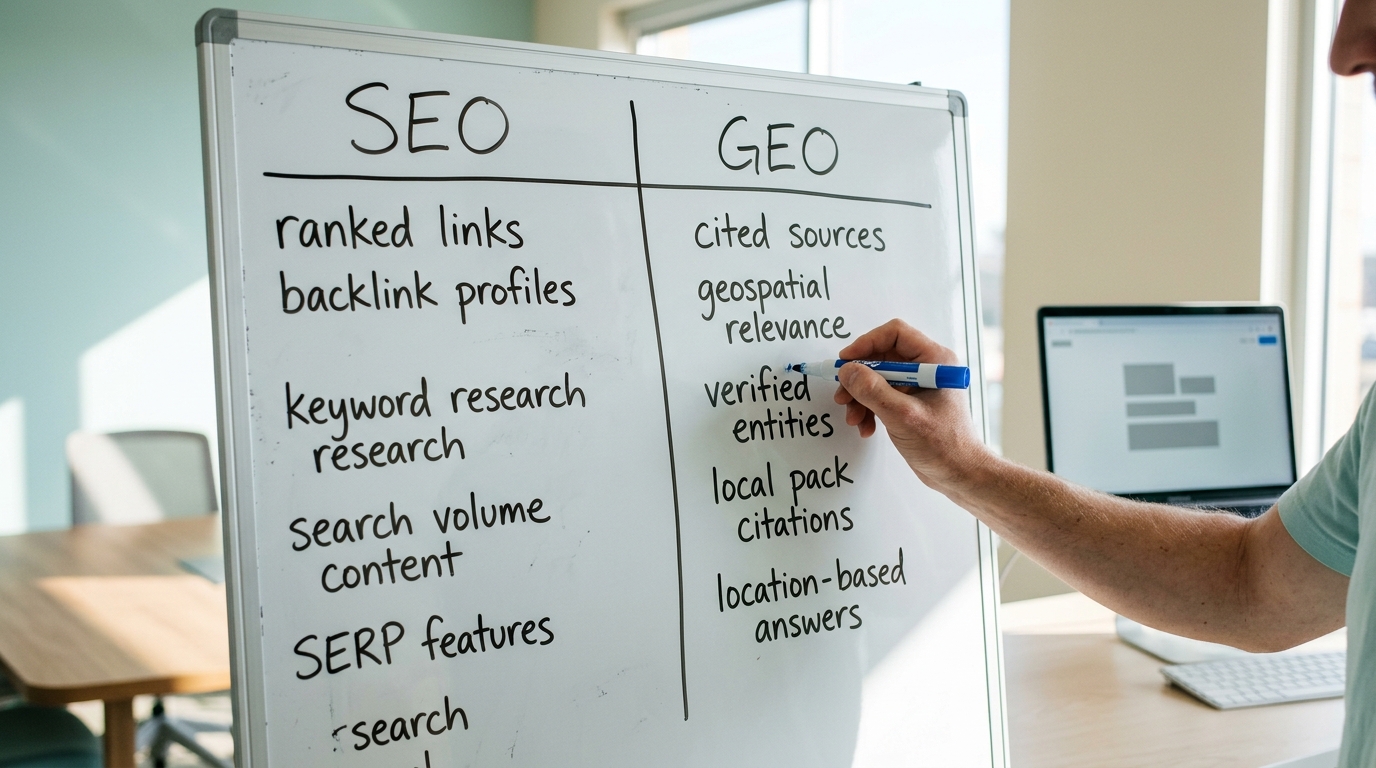
Generative Engine Optimization (GEO) is the practice of optimizing digital content to be discovered, understood, and surfaced by AI-driven search engines and conversational agents like Google SGE and Perplexity. Unlike traditional SEO, which focuses on ranking in a list of links, GEO prioritizes being cited as a source in a generated answer.
What is Generative Engine Optimization (GEO)?
Generative Engine Optimization (GEO), also known as AI Engine Optimization (AEO), represents a strategic shift in digital marketing. For years, Search Engine Optimization (SEO) was the undisputed king of organic traffic. The goal was simple: get your webpage to the top of Google's "10 blue links." But with the rapid integration of large language models (LLMs) into search engines - like Google's Search Generative Experience (SGE) - that landscape has fundamentally changed.
Instead of just presenting a list of links, these new search engines synthesize information from multiple sources to create a direct, conversational answer to a user's query. GEO is the process of making sure your brand's information is a primary source for these AI-generated answers. It's not about ranking #1 anymore; it's about becoming a citable authority that the AI trusts and references.
For a small business owner, this means moving beyond just keywords and backlinks. GEO requires a deeper focus on factual accuracy, structured data, and demonstrating verifiable expertise in your niche.
SEO vs. GEO: 5 Key Differences for Your Business in 2026
While SEO fundamentals remain important, GEO introduces new priorities and tactics. Understanding these differences is critical for allocating your marketing resources effectively in 2026.
GEO vs. SEO: A Strategic Comparison
-
Goal:
- SEO: Rank high in a list of organic search results (SERPs).
- GEO: Become a cited source within an AI-generated answer or conversational response.
-
Primary Focus:
- SEO: Keywords, backlinks, and on-page technical health to signal relevance to crawlers.
- GEO: Factual accuracy, structured data (Schema), authoritativeness (E-E-A-T), and clear sourcing to be parsed by LLMs.
-
Content Strategy:
- SEO: Create long-form content optimized around a primary keyword and related secondary keywords.
- GEO: Create highly specific, citable "knowledge units" that directly answer questions, supported by original data and clear attribution.
-
Key Metrics:
- SEO: Keyword rankings, organic traffic, click-through rate (CTR), backlink count.
- GEO: AI visibility (mentions/citations in AI answers), attributed clicks from generative results, brand mentions.
-
Technical Elements:
- SEO: Site speed, mobile-friendliness, robots.txt, sitemaps.
- GEO: All of the above, plus advanced Schema markup, content pruning for clarity, and internal linking that establishes a clear knowledge graph for your site.
How to Optimize for AI Search: Your GEO Checklist
Adapting your strategy doesn't mean abandoning SEO. It means enhancing it with a GEO-focused lens. Here’s where to start.
1. Master E-E-A-T: The Foundation of AI Trust
E-E-A-T (Experience, Expertise, Authoritativeness, and Trustworthiness) is no longer just an SEO concept; it's the bedrock of GEO. AI models are trained to prioritize information from sources that demonstrate these qualities.
- Experience: Write from a first-hand perspective. If you're a retail owner, share specific challenges you've overcome. Include case studies and original photography.
- Expertise: Publish original research, data, or unique insights. For an ecommerce store, this could be a detailed analysis of 2026 consumer trends in your niche.
- Authoritativeness: Ensure your author bios are detailed. Link to professional profiles (like LinkedIn). Secure mentions and links from other reputable sites in your industry.
- Trustworthiness: Make your contact information, privacy policy, and terms of service easy to find. Cite your sources clearly and link out to other authoritative domains.
2. Structure Your Data with Advanced Schema Markup
If E-E-A-T is the language of trust, Schema markup is the grammar that AI engines understand. It's code you add to your website to explicitly tell search engines what your content is about. For GEO, this is non-negotiable.
- Beyond the Basics: Go beyond basic `Organization` and `Product` schema. Use `FAQPage` schema for question-and-answer sections, `HowTo` schema for tutorials, and `Person` schema for author pages.
- Link Your Entities: Use the `@id` property in your schema to connect different entities. For example, explicitly link the `author` of an `Article` to their `Person` schema page. This builds a clear "knowledge graph" of your website that LLMs can easily interpret.
- Validate Everything: Use tools like the Schema Markup Validator to ensure your code is error-free.
3. Create Citable "Knowledge Units"
AI engines look for concise, factual, and easily verifiable pieces of information - what we can call "knowledge units." Instead of writing a single 3,000-word blog post, think about breaking it into distinct, answer-oriented sections.
- Directly Answer Questions: Use clear headings that pose a question (e.g., "What is the Average Conversion Rate for a Shopify Store in 2026?") and answer it directly in the first paragraph that follows.
- Use Data and Numbers: AI loves quantifiable facts. Instead of "our product improves efficiency," write "our product improves efficiency by an average of 17% according to our 2025 customer survey."
- Attribute Everything: If you use a statistic, link to the primary source. This demonstrates trustworthiness to both users and AI models.
4. Track Your AI Visibility
You can't improve what you don't measure. Traditional rank trackers are becoming less relevant in an AI-driven world. New tools and methods are emerging to track GEO performance.
- Manual Checks: Regularly ask generative search engines (Google SGE, Perplexity) questions that your customers would ask. See if your brand is mentioned or cited.
- GEO Tracking Platforms: As of 2026, platforms like BrightEdge and seoClarity have integrated "AI Visibility" or "SGE Mention" tracking. These tools monitor when your domain appears as a citation in generative results.
- Brand Monitoring: Set up alerts using tools like Google Alerts or Mention to track when your brand name is discussed online, as this can be an indicator of your growing authority.
The shift from a list of links to a single, synthesized answer is the most significant change to search in a generation. By embracing GEO now, you position your small business not just to survive this change, but to become a trusted authority in the new age of AI-driven discovery.
What is Generative Engine Optimization (GEO)?
Generative Engine Optimization (GEO) is the process of optimizing web content and technical signals to be favorably interpreted, cited, and recommended by AI-driven search engines and conversational interfaces. The goal is to become a trusted source within AI-generated answers.
Is SEO dead in 2026?
No, SEO is not dead, but it is evolving. The core principles of SEO - technical health, quality content, and authority - are now the foundation for GEO. However, solely focusing on traditional ranking factors without adapting for AI-generated results will lead to a significant loss of visibility and traffic.
How do I measure the ROI of GEO?
Measuring the ROI of GEO involves tracking new metrics. Key performance indicators (KPIs) include: "AI Visibility" (the percentage of target queries where your site is cited), clicks from AI-generated answer carousels, increases in branded search volume (as users search for you after seeing you cited), and conversions attributed to traffic from these new search features.
What's the difference between AEO and GEO?
AEO (AI Engine Optimization) and GEO (Generative Engine Optimization) are largely interchangeable terms used to describe the same practice: optimizing for AI-driven search experiences. Some practitioners prefer AEO as a broader term, while GEO specifically highlights the "generative" nature of the AI's output, but they refer to the same strategic goals.