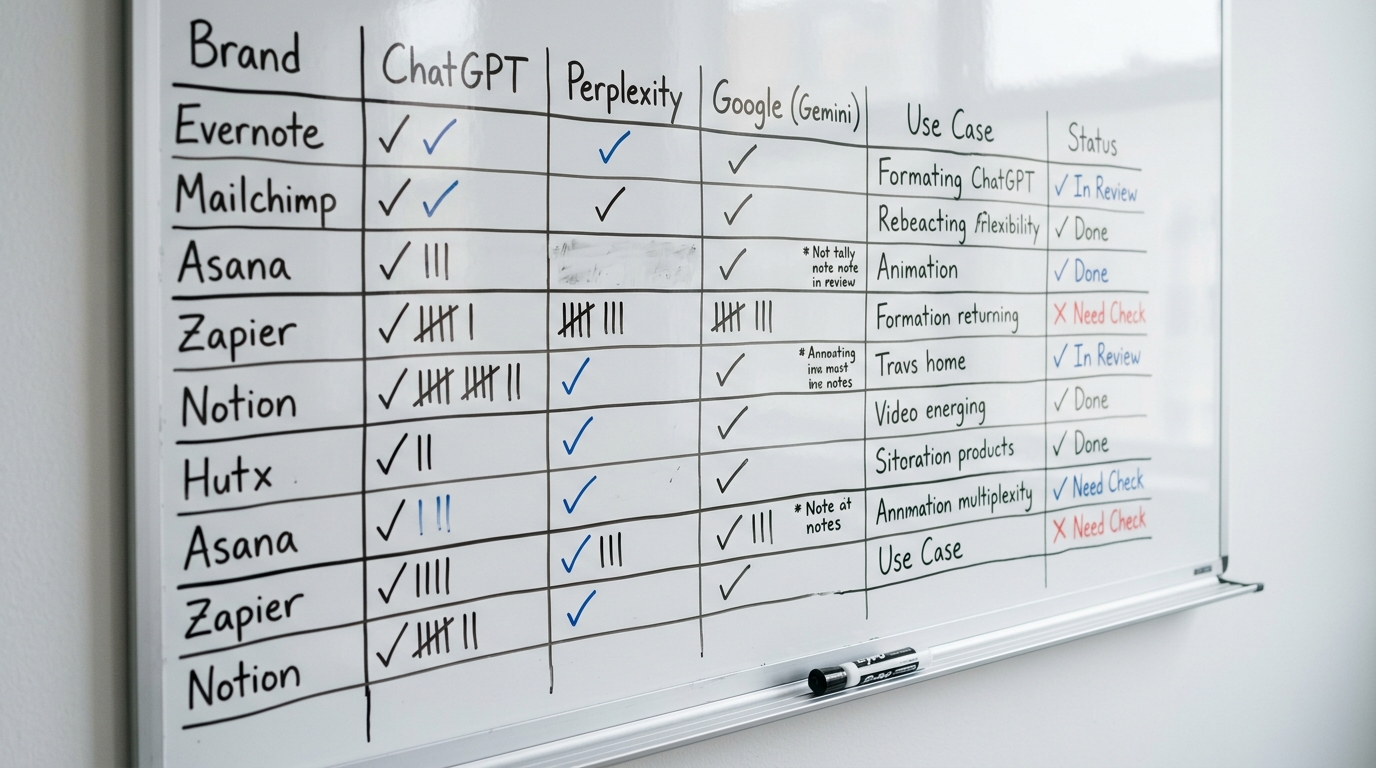
An AI citation audit is the process of tracking, measuring, and analyzing how AI-powered search engines, like Google's AI Overviews and Perplexity, cite your brand, content, and products as sources in their generative responses. This audit is crucial for understanding your AI search visibility and measuring referral traffic from these new channels.
Why Your Standard SEO Dashboard Is Now Incomplete
For years, your digital marketing success was measured by a familiar set of KPIs: keyword rankings, click-through rates (CTR), and organic traffic. You could log into Google Search Console, see your impressions and clicks, and know where you stood. However, the rise of AI-powered search has fundamentally changed this landscape. As of 2026, a significant portion of search queries, especially complex and commercial ones, are answered directly by AI models, not by a list of blue links.
This creates a new challenge for business owners: your content can be used to generate an answer without the user ever clicking through to your site. Your brand might be mentioned, your data cited, or your product recommended, but traditional analytics tools won't capture this "implied" visibility. An AI citation audit fills this gap, helping you understand your performance in this new "zero-click" yet high-influence environment.
Without this audit, you are blind to critical questions:
- Is Google's AI Overview citing my brand when users ask about "best running shoes for flat feet"?
- Is Perplexity summarizing my blog post accurately, or is it misrepresenting my advice?
- When a user asks ChatGPT for project management software, is my product mentioned alongside competitors like Asana and Trello?
- How much traffic is actually coming from the citation links within AI Overviews?
The 4-Step AI Citation Audit Process
Conducting an effective audit requires a new set of tools and a methodical approach. Here is a step-by-step guide to get started.
Step 1: Identify Your Core "Generative Keywords"
Just as you have target keywords for traditional SEO, you need to identify the queries most likely to trigger AI-generated answers relevant to your business. These often fall into specific categories:
- Comparative questions: "Shopify vs. BigCommerce for small business"
- "Best of" queries: "best email marketing software for retail in 2026"
- How-to and instructional searches: "how to set up conversion tracking in WooCommerce"
- Product discovery questions: "what are some alternatives to Mailchimp"
Compile a list of at least 20-30 core generative keywords that represent your most valuable products, services, and content pillars. These will be the foundation of your audit.
Step 2: Choose Your AI Tracking Tools
Manual checks are inefficient and don't scale. In 2026, a new category of "Generative Engine Optimization" (GEO) software has emerged to automate this process. These platforms monitor AI search results and track your brand's citations.
Key tools for your AI citation audit stack:
- Authoritas: A pioneer in this space, Authoritas tracks your visibility within Google's AI Overviews (formerly SGE) and provides a "Share of AI Voice" metric.
- AlsoAsked: While traditionally a "People Also Ask" tool, its new AI modules help you understand the question-based context where your brand could be cited.
- SEMrush & Ahrefs: Major SEO platforms have integrated AI citation tracking. As of late 2025, SEMrush's Position Tracking tool began offering features to monitor when your domain appears as a source in AI-generated answers.
- Custom API Scripts: For advanced users, using APIs from services like Bright Data or an AI search API can allow you to programmatically check your generative keywords across different AI models (Google, Perplexity, etc.) and log the results.
Step 3: Track Key Generative Engine Optimization (GEO) KPIs
Your audit needs to measure more than just a mention. Focus on these four essential GEO metrics to get a complete picture of your performance.
- Citation Frequency: For your target generative keywords, what percentage of the time is your domain cited as a source? This is your primary AI visibility metric. A goal of 25% or higher for your top 10 keywords is a strong benchmark for 2026.
- Citation Placement: In a multi-source AI answer, is your citation first, second, or further down? Just like organic rankings, placement matters. The first citation in an AI Overview receives disproportionately more attention and clicks.
- Sentiment and Accuracy: Does the AI summary accurately reflect your content's position? Is the sentiment positive or neutral? Track instances where the AI misinterprets your information, as this can harm your brand and requires content clarification.
- AI-Referred Traffic: Use Google Search Console and your web analytics. GSC has started to differentiate clicks from AI Overviews. Isolate this traffic segment to measure its volume, conversion rate, and user engagement. Compare its performance against your traditional organic traffic.
Step 4: Analyze and Optimize Your Content
An audit is only useful if it leads to action. Use your findings to inform your content strategy.
- Strengthen E-E-A-T: AI models heavily favor sources with strong Experience, Expertise, Authoritativeness, and Trustworthiness signals. Ensure your content has clear author bios, cites original data, and is published on a technically sound website.
- Use Schema Markup: Structure your data with schemas like
FAQPage,HowTo, andProduct. This makes it easier for AI models to parse and digest your information accurately, increasing the likelihood of a high-quality citation. - Answer Questions Directly: Structure your content to provide clear, concise answers to the generative keywords you identified. Use headings, lists, and tables. The more easily digestible your content, the more "citable" it becomes.
- Address Citation Gaps: If competitors are being cited for a key term and you aren't, analyze their source page. What makes it a better source? Is it more comprehensive? Does it have unique data? Create content that is demonstrably better and more helpful.
AI Citation Audit: Manual vs. Automated Tools
Deciding how to perform your audit depends on your scale and budget. Here’s a comparison of the two primary approaches.
Manual Auditing
- Process: Manually searching your generative keywords in an incognito browser and recording citations in a spreadsheet.
- Pros: No cost, good for small businesses with a limited number of core keywords.
- Cons: Time-consuming, prone to personalization bias, difficult to track over time, doesn't provide historical data.
- Best for: Businesses just starting to explore GEO with less than 20 keywords to track.
Automated Tool Auditing
- Process: Using a subscription service like Authoritas or SEMrush to automatically track hundreds of keywords daily across different locations and devices.
- Pros: Scalable, provides historical trend data, offers competitor analysis, removes personalization bias.
- Cons: Monthly cost (typically starting around $100-$300/month for robust tracking).
- Best for: Any business serious about competing in AI-powered search results.
As AI becomes the dominant interface for information discovery, understanding your brand's presence within it is no longer optional. An AI citation audit is the first step toward building a resilient digital marketing strategy that thrives in the generative era. Start tracking your citations today to protect and grow your online visibility for tomorrow.
Ai Search Visibility FAQ
What is Generative Engine Optimization (GEO)?
Generative Engine Optimization (GEO) is the practice of optimizing digital content and brand information to be favorably discovered, cited, and recommended by AI-powered search engines and chatbots like Google's AI Overviews, Perplexity, and ChatGPT.
How often should I conduct an AI citation audit?
For high-priority keywords, you should use an automated tool for daily or weekly tracking. For a comprehensive manual audit, conducting one on a quarterly basis is a reasonable starting point for most small businesses to identify trends and opportunities.
Can I be cited by an AI without getting a link or traffic?
Yes. This is known as an "implied citation." An AI model might mention your brand name or a statistic from your study without providing a direct, clickable link. While this doesn't generate traffic, it builds brand awareness and authority, which are key indirect benefits to track in your audit.
What's the difference between AI search visibility and traditional SEO rankings?
Traditional SEO rankings measure your position in a list of ordered blue links (e.g., "ranking #3 on Google"). AI search visibility measures if, and how often, your brand or content is used as a source within the AI-generated answer itself. You can have high AI visibility without having a top-ranking traditional link.