Law firm marketing under real advertising rules
Legal is the most expensive click in local search and one of the most tightly regulated categories anyone markets in. We build practice-area depth and local authority that earns the case without writing anything your state bar would take issue with.
How is marketing a law firm different from other local marketing?
Legal content sits in a category search engines hold to a higher standard of authorship and accuracy, and state bar advertising rules govern what a firm may claim and how testimonials and disclaimers are handled, so review requests and rating markup stay deliberately conservative. Compliance judgment remains with the firm. Structurally, practice area crossed with jurisdiction carries the search.
YMYL content, bar rules and brutal click costs
Legal search punishes carelessness in three directions at once. Search engines treat legal advice as a your-money-or-your-life topic and hold it to a higher standard of authorship and accuracy than almost any other subject. State bar advertising rules govern what a firm may claim, how testimonials may be used and what disclaimers must appear. And the paid auction for high-value case types is among the costliest anywhere, which means a wasted click is genuinely expensive. Marketing a firm well is mostly a discipline problem, not a creativity problem.
Bar advertising rules vary by state
Specialization claims, testimonials, past results and required disclaimers are all regulated, and the rules differ across the states a firm is licensed in.
Google holds legal content to a higher bar
Google's guidance asks for accurate, attributed authorship where a reader would expect it, and an anonymous article gives a prospective client no reason to trust it either.
The paid auction is unforgiving
Case-type keywords in personal injury and family law are among the most expensive in any industry, so match types, negatives and intake quality matter more than budget size.
Intake loses more cases than marketing does
An unanswered call at 5:40pm is a case that went to the next firm on the list. Response time is a marketing metric whether or not anyone measures it that way.
Practice areas are separate markets
Estate planning, criminal defense and employment law share nothing but a letterhead. Each needs its own content, its own geography and its own conversion path.
Reviews are constrained by confidentiality
Clients cannot always be asked publicly, and some matters should never be identified. Review generation has to be designed around that rather than borrowed from retail.
Real law firm sites, running on WorkspaceCMS
Every one of these is a live site you can click through, not a mockup. Yours is built on the same platform.
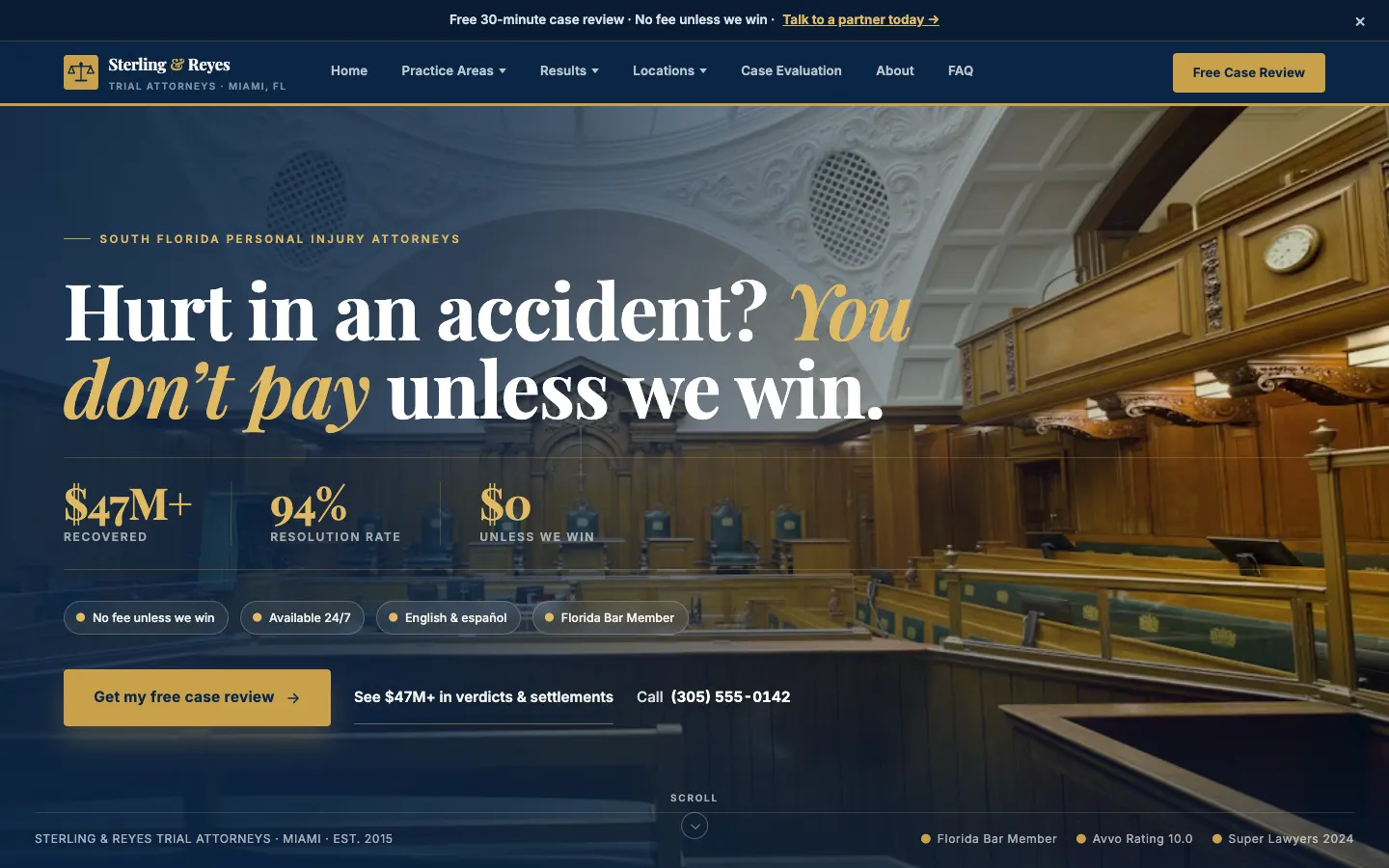 Personal Injury LawPractice-area pages and case results, structured so Google understands the firm.Open the live demo
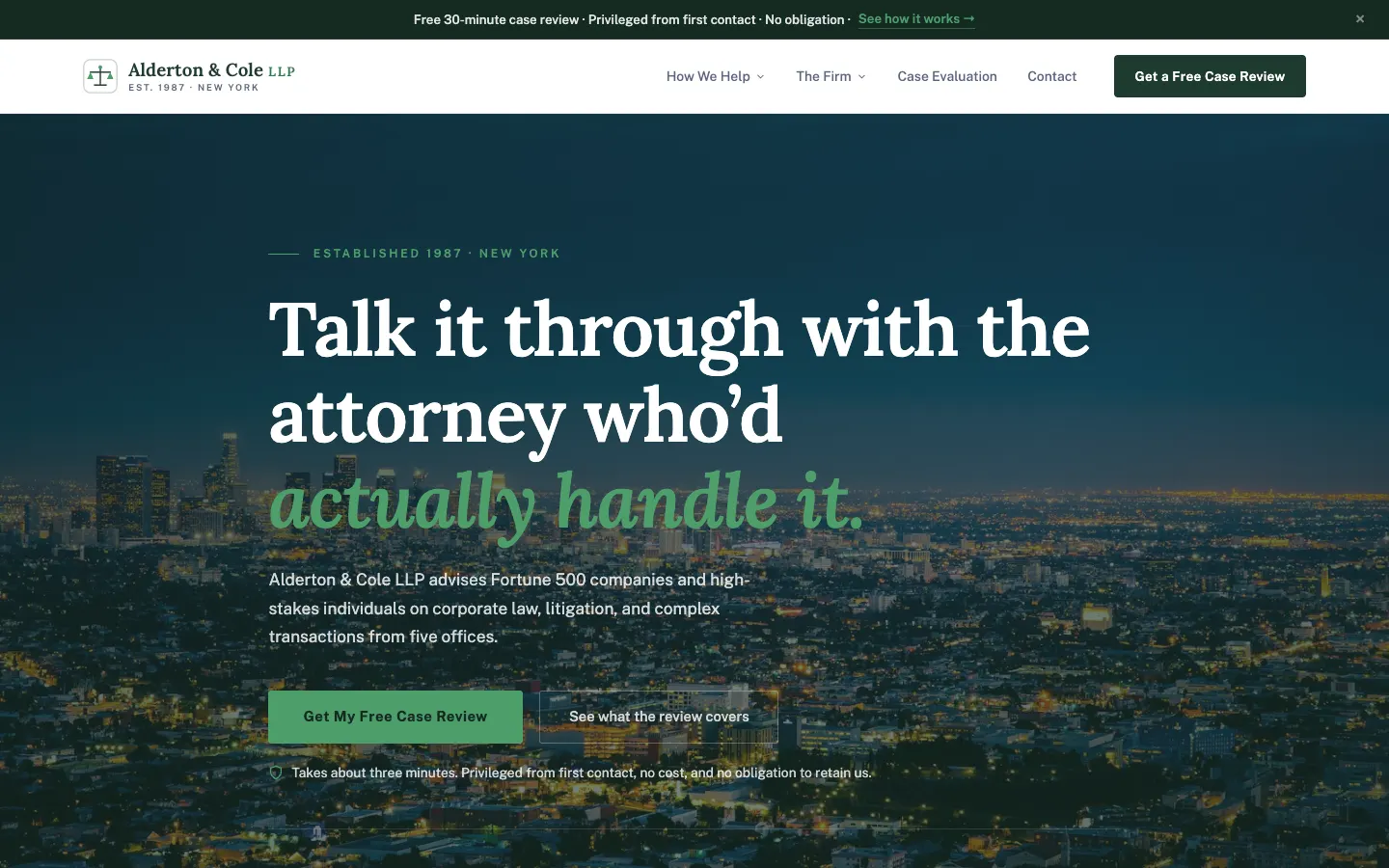 National Law FirmAlderton & Cole LLP — 14-Attorney Directory + 5 National Offices + 8 Practice GroupsOpen the live demo
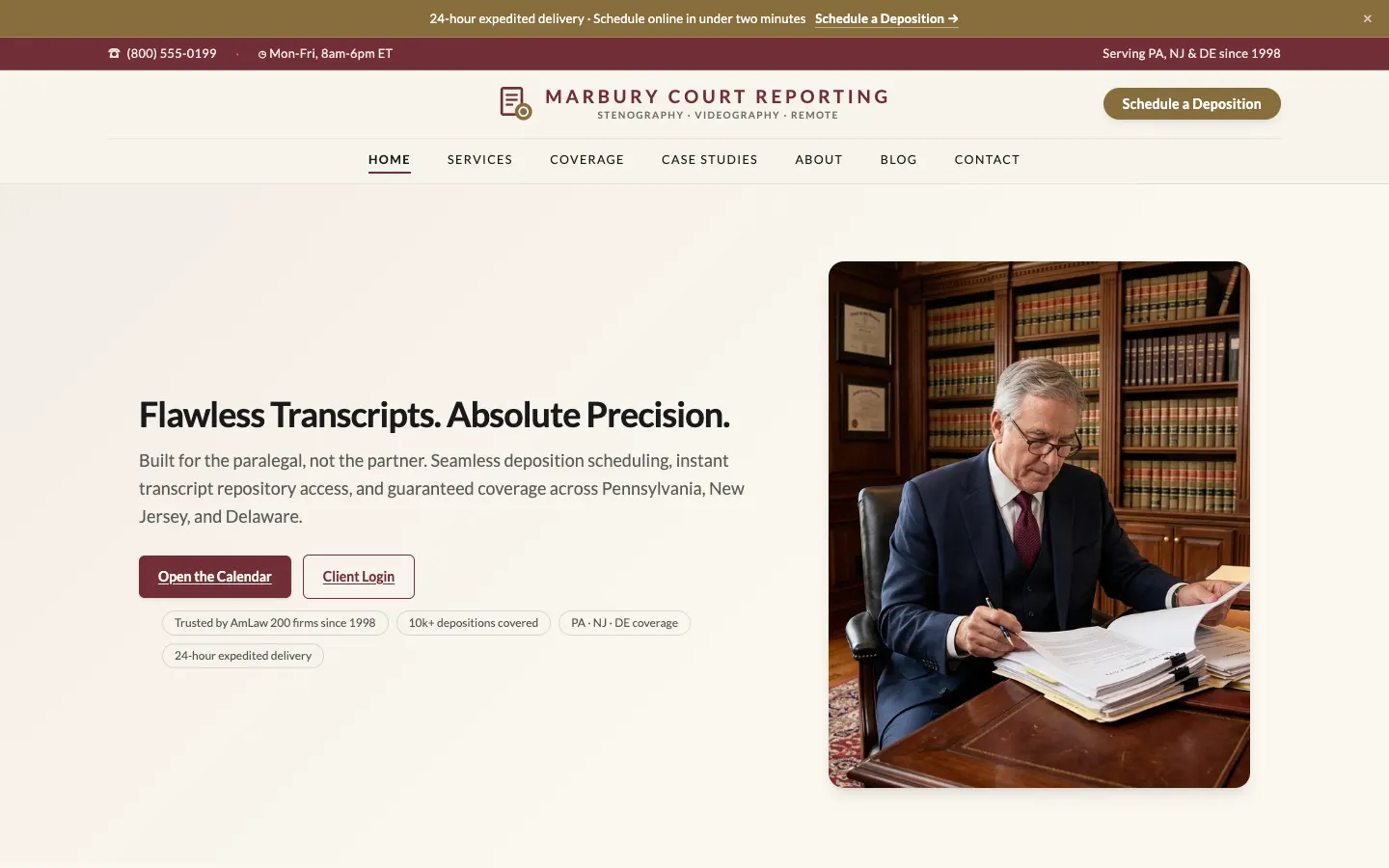 Court ReportingMarbury Court Reporting — Deposition Scheduling Request + PA/NJ/DE Coverage PageOpen the live demo
Every demo is a real, live site you can click through - see the full gallery
The surfaces that decide who gets the call
Practice area crossed with jurisdiction
A page per practice area per county or city, written with the local courts and procedures in mind, is the architecture that carries legal local search.
Question-shaped research queries
People search their situation long before they search for a lawyer. Answering the procedural questions of your practice area is how a firm enters that decision early.
Attorney profiles as entity signals
Bar admissions, credentials, publications and consistent professional profiles connect the firm to real, verifiable people, which is what this category rewards.
Compliant review and rating handling
Review requests that respect confidentiality, and structured data that never fabricates a rating claim, because a self-serving markup in this category is a real risk.
Need the Law Firms website itself?
WorkspaceCMS is our AI-powered CMS - built for SEO and for how AI assistants read a site. We build the site for free and run it on a monthly plan, and Genius runs the marketing on top of it.
See WorkspaceCMS plans- A fast, SEO-ready site with structured data built in
- The site build itself is included, with no setup fee
- Content and page structure an AI assistant can actually cite
- Local business schema, service areas and review surfaces
- Genius runs SEO, GEO/AEO and paid on top of it
How we build a law firm program
Establish the compliance boundary first
We work through the advertising rules in every state you are licensed in, and the disclaimers they require, before writing anything, so nothing has to be pulled after it ranks. Your compliance counsel signs off, not us.
Choose the practice areas to actually contest
A firm rarely wins every area it lists. We concentrate the content and budget where the case value, your track record and the competitive gap actually line up.
Build attributed, reviewed content
Substantive practice-area and jurisdiction pages authored or reviewed by named attorneys, with credentials attached, which is what this category requires to compete.
Fix intake before scaling spend
Response times, after-hours coverage and consultation booking, because increasing traffic into a leaking intake process just raises your cost per signed case.
Law Firms marketing - frequently asked questions
Will you write copy that violates our state bar rules?
Our job is to keep your marketing well inside the lines. We work from the advertising rules of each state where the firm is licensed, keep required disclaimers in place, and avoid specialization language, guarantees and result claims unless the rules and the facts both support them. Anything close to the line goes to the firm for approval before it publishes. We are a marketing agency and not your counsel, so final responsibility for bar compliance stays with the firm.
Can we publish past case results?
It depends entirely on your jurisdiction, and several states restrict it or require specific accompanying disclaimers. Where it is allowed and you want to, we handle it carefully. Where it is not, there are stronger approaches anyway, including procedural depth and attorney credentials.
Paid search in our practice area is extremely expensive. Is it worth it?
Sometimes, and only with tight control. In high-value case types the cost per click is high but the case value is far higher, so the deciding factor is intake quality and negative keyword discipline rather than budget. In practice areas with lower case value, organic and content usually return more per dollar.
How do we get reviews without breaching confidentiality?
By asking at the right moment, in matters where it is appropriate, with a process that never identifies facts about a case. Some practice areas will always have thinner review profiles than others, and the answer there is to lean on credentials, publications and referral relationships instead of chasing volume.
Why would a law firm want WorkspaceCMS?
Because legal content changes when the law does, and a firm should not need a change order to update a page after a statute is amended. It is AI-powered, built for SEO, and the site build is included. Genius provides the strategy, the content program and the campaigns that run on it.
