Benchmarking Competitor Trust Signals for Generative AI: A Practical Guide for Small Business Owners
Competitor trust signal benchmarking for generative AI means systematically identifying which sources, brand names, and factual claims AI engines like ChatGPT Search, Google AI Overviews, and Perplexity cite - and then reverse-engineering why your competitors appear there instead of you. Traditional rank tracking tools measure blue-link positions; AI citation analysis measures something deeper: credibility architecture.
If your competitors are being quoted by AI assistants and you are not, you are losing top-of-funnel visibility in a channel that now influences purchasing decisions before a single click happens. This guide shows you exactly how to audit that gap and close it.
Why AI Citation Visibility Is Different from Traditional SEO Rankings
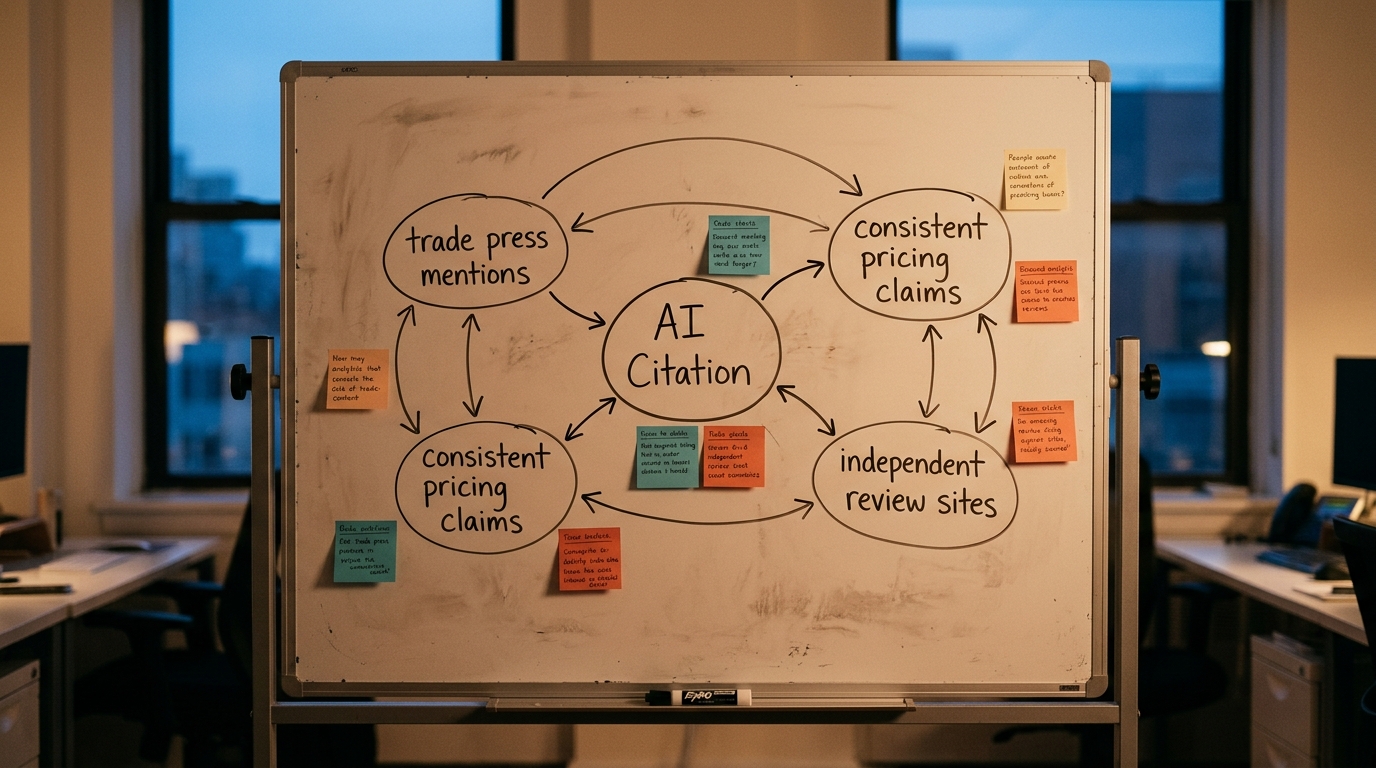
Traditional SEO ranks a URL. Generative AI cites an entity- a brand, a person, a data point, or a claim. Google's AI Overviews, Perplexity's answer engine, and ChatGPT Search all pull from a layered trust model that weights three signals above raw domain authority:
- Source diversity: Is your brand mentioned across independent publications, not just your own site?
- Claim consistency: Does every authoritative source say the same thing about your product, price, or service?
- Temporal freshness: Were those mentions published or updated within the last 12–18 months?
A competitor ranking #4 on a traditional SERP can still dominate AI responses if they score higher on these three dimensions. That is the gap most small business owners are not measuring yet.
Step 1 - Run a Structured AI Citation Gap Analysis
An AI citation gap analysis compares which competitors get named in AI-generated answers for your target queries versus which ones get ignored. Here is a repeatable process:
- Build a query set. Write 20–30 informational and commercial queries your ideal customer types. Include "best [product category] for [use case]," "how does [service] work," and "[competitor name] vs alternatives."
- Run each query across three AI engines. Use ChatGPT Search, Perplexity, and Google AI Overviews on the same day. Log which brand names appear in the generated answer text - not just the cited URLs.
- Tally mention frequency. Build a simple spreadsheet with competitor names as rows and queries as columns. Mark each cell where a competitor is named. A competitor mentioned in 18 out of 30 queries has a citation frequency of 60%.
- Identify your citation frequency. Run the same audit for your own brand. If competitors average 45% citation frequency and you are at 8%, you have a measurable gap to close.
Repeat this audit monthly. AI training data refreshes continuously, and citation patterns shift faster than traditional search rankings.
Step 2 - Decode Competitor Trust Signal Architecture
Once you know who gets cited, investigate why. For each top-cited competitor, analyze the following trust signal categories:
Trust Signal Type What to Look For Where to Check Third-party editorial mentions Named in listicles, reviews, industry roundups Google site search, Ahrefs referring domains Structured data completeness Schema markup for Product, FAQ, Review, Organization Google Rich Results Test, Schema Markup Validator Wikipedia / Wikidata entity Has a verified Knowledge Panel or Wikidata entry Google Knowledge Panel search, Wikidata.org Review platform depth Volume and recency of reviews on G2, Trustpilot, Google Business Direct platform search Original data or research Publishes statistics or studies other sites cite Ahrefs Content Explorer, BuzzSumoThe competitors winning AI citations almost always score strongly on at least three of these five categories. Identify which categories they dominate and which ones you can realistically close first.
Step 3 - Map Competitor GEO Strategy
Generative Engine Optimization (GEO) is the practice of structuring content so AI engines extract and cite it accurately. Your competitors may be executing a deliberate GEO strategy even if they do not call it that. Signs of a mature competitor GEO strategy include:
- Dedicated FAQ pages that mirror the exact phrasing of common voice and AI queries
- Comparison pages titled "[Their Brand] vs [Competitor]" - these get cited heavily in "alternatives" queries
- Statistics pages with original research that other publications link to and AI engines quote
- Author bio pages with verified credentials, LinkedIn profiles, and external publication history (E-E-A-T signals)
- Consistent NAP (Name, Address, Phone) data across 50+ business directories, anchoring local entity recognition
Map these elements for your top three competitors in a side-by-side document. Every item they have that you do not is a concrete action item - not a vague "improve authority" suggestion.
Step 4 - Track Competitor AI Visibility Over Time
Tracking AI visibility requires a different toolset than traditional rank monitoring. As of 2026, the most practical approaches for small business owners are:
- Manual query logging: Run your core query set weekly in ChatGPT Search and Perplexity, screenshot or copy the answer text, and log brand mentions in a spreadsheet. Low cost, high accuracy.
- Semrush AI Toolkit: Semrush added AI visibility tracking features that flag when your domain or competitor domains appear in AI Overview snippets for tracked keywords.
- Perplexity Pages monitoring: Search your competitors' brand names directly in Perplexity to see what summary the AI constructs about them. Compare it to the summary it generates for your brand.
- Brand mention alerts: Set up Google Alerts and Mention.com alerts for competitor names combined with terms like "best," "recommended," or "according to." These alert you when new editorial content is published that could feed AI training pipelines.
Set a 90-day benchmark before expecting meaningful data. AI citation patterns change gradually, and single-week snapshots are noisy.
Step 5 - Build Content That Closes the Citation Gap
Once your analysis identifies the specific trust signals your competitors have and you lack, prioritize content investments in this order:
- Original statistics or survey data. Publishing one piece of proprietary research generates citations for 18–24 months on average. AI engines disproportionately cite named statistics.
- Structured comparison content. Write honest, detailed comparison pages between your product and direct competitors. These pages satisfy high-intent queries and get cited in "X vs Y" and "alternatives to X" AI responses.
- Deep FAQ content aligned to AI query patterns. Use the actual phrasing from your query set in Step 1. Write answers in 40–60 word paragraphs - the length AI engines prefer for direct extraction.
- Third-party editorial placements. Pitch guest articles, product reviews, or expert quotes to industry publications. A single mention in a high-authority publication carries more AI citation weight than 10 self-published blog posts.
For ecommerce businesses on Shopify, BigCommerce, or WooCommerce, product schema and review schema are the fastest wins. Ensure every product page has complete structured data, and actively solicit reviews on platforms AI engines index heavily.
Measuring Progress: Key Metrics to Track
- Citation frequency rate: Percentage of your core query set where your brand appears in AI-generated answers
- Citation sentiment ratio: Positive vs. neutral vs. negative framing in AI summaries about your brand
- Source diversity score: Number of unique referring domains that mention your brand name (not just link to you)
- Competitor citation gap: Difference between your citation frequency and the leading competitor's frequency
Review these metrics monthly and tie them to changes in direct traffic and branded search volume- the two downstream metrics most correlated with AI-driven brand discovery.
Ai Search Competitor Analysis FAQ
What is AI citation gap analysis and why does it matter for small businesses?
AI citation gap analysis measures how often your brand appears in AI-generated answers compared to competitors for your target queries. It matters because generative AI engines like ChatGPT Search and Google AI Overviews now influence buying decisions before users visit any website. A citation gap means competitors are shaping customer perception before you get any visibility at all.
How is tracking competitor AI visibility different from traditional rank tracking?
Traditional rank tracking monitors URL positions in a static results page. AI visibility tracking monitors whether your brand name, claims, or content are extracted and cited inside a generated text response. A competitor can rank #8 on Google and still dominate AI responses because they score higher on entity authority, source diversity, and structured data completeness.
What is a competitor GEO strategy and how do I identify if a competitor is using one?
A competitor GEO (Generative Engine Optimization) strategy is a deliberate approach to structuring content so AI engines cite it accurately. Signs include dedicated FAQ pages, comparison content, original statistics pages, and consistent structured data across the site. If a competitor consistently appears in AI answers across multiple query types, they are almost certainly executing some version of a GEO strategy.
Which AI search engines should I benchmark competitor visibility on?
Benchmark on ChatGPT Search, Perplexity, and Google AI Overviews as a minimum. These three platforms collectively cover the majority of AI-assisted search behavior as of 2026. For B2B businesses, also monitor Microsoft Copilot, which integrates into enterprise workflows and pulls from Bing's index.
How long does it take to close an AI citation gap after publishing new content?
Expect 60–120 days for new content to influence AI citation patterns meaningfully. AI engines refresh their knowledge sources on varied schedules, and third-party editorial placements - which carry the most citation weight - take additional time to accumulate. Original research and statistics tend to gain citations fastest, often within 30–45 days of being picked up by other publications.