How to Perform a Competitor AI Citation Gap Analysis
An AI citation gap analysis identifies which competitors are being cited by AI search engines (ChatGPT, Gemini, Perplexity, Copilot) in response to queries where your brand is absent. Run one quarterly to find structural content and authority gaps that traditional SERP analysis misses entirely.
As of 2026, AI-native search handles a significant share of commercial research queries. When a potential customer asks Perplexity "What's the best inventory management tool for Shopify stores?" and your competitor gets named but you don't, you've lost a high-intent lead before a single click occurred. That's an AI citation gap — and most small business owners have no system for finding or closing them.
Why AI Citation Gaps Differ from Traditional Keyword Gaps
Traditional keyword gap analysis compares SERP rankings between you and a competitor for a set of target keywords. AI citation gap analysis is structurally different across five dimensions:
Dimension Traditional SEO Gap Analysis AI Citation Gap Analysis Output measured Ranking position (1–100) Named citation or omission in AI response Query format Short-tail keywords Conversational, intent-driven questions Ranking signal Links, on-page SEO, technical factors Entity authority, source trustworthiness, structured data, review signals Visibility unit URL ranking Brand or entity name mention Tool support Mature (Ahrefs, Semrush, Moz) Emerging (Profound, Brandwatch AI, manual query mapping)Understanding this distinction prevents you from applying the wrong fix. Adding more backlinks won't help if the real issue is that AI models don't associate your brand with a specific use case or product category.
Step 1: Build Your AI Query Universe
Start by listing 30–50 conversational questions your ideal customer asks during the research phase of a purchase. These are not keywords — they are full-sentence prompts. Examples for an ecommerce brand selling ergonomic office chairs might include:
- "What are the best ergonomic office chairs under $500?"
- "Which office chair brands are recommended by physical therapists?"
- "What should I look for in a lumbar support chair for remote work?"
- "How does [Brand A] compare to [Brand B] for all-day sitting?"
- "Are there ergonomic chair options that ship to Canada within a week?"
Organize these into intent clusters: awareness, comparison, use-case-specific, and local/logistics. Each cluster will reveal different types of citation gaps and require different content responses.
Step 2: Run Systematic Competitor Citation Audits
Manually query ChatGPT (GPT-4o), Perplexity, Google Gemini, and Microsoft Copilot with each prompt from your query universe. For each response, record:
- Which brand names are cited — list every competitor mentioned by name
- Your brand's presence — cited, mentioned in passing, or completely absent
- The framing of citations — is the competitor called "best for budget," "most trusted," or "recommended by experts"?
- Source links surfaced — which URLs does the AI pull from (especially in Perplexity and Copilot)?
- Response consistency — run the same prompt twice to check for variation
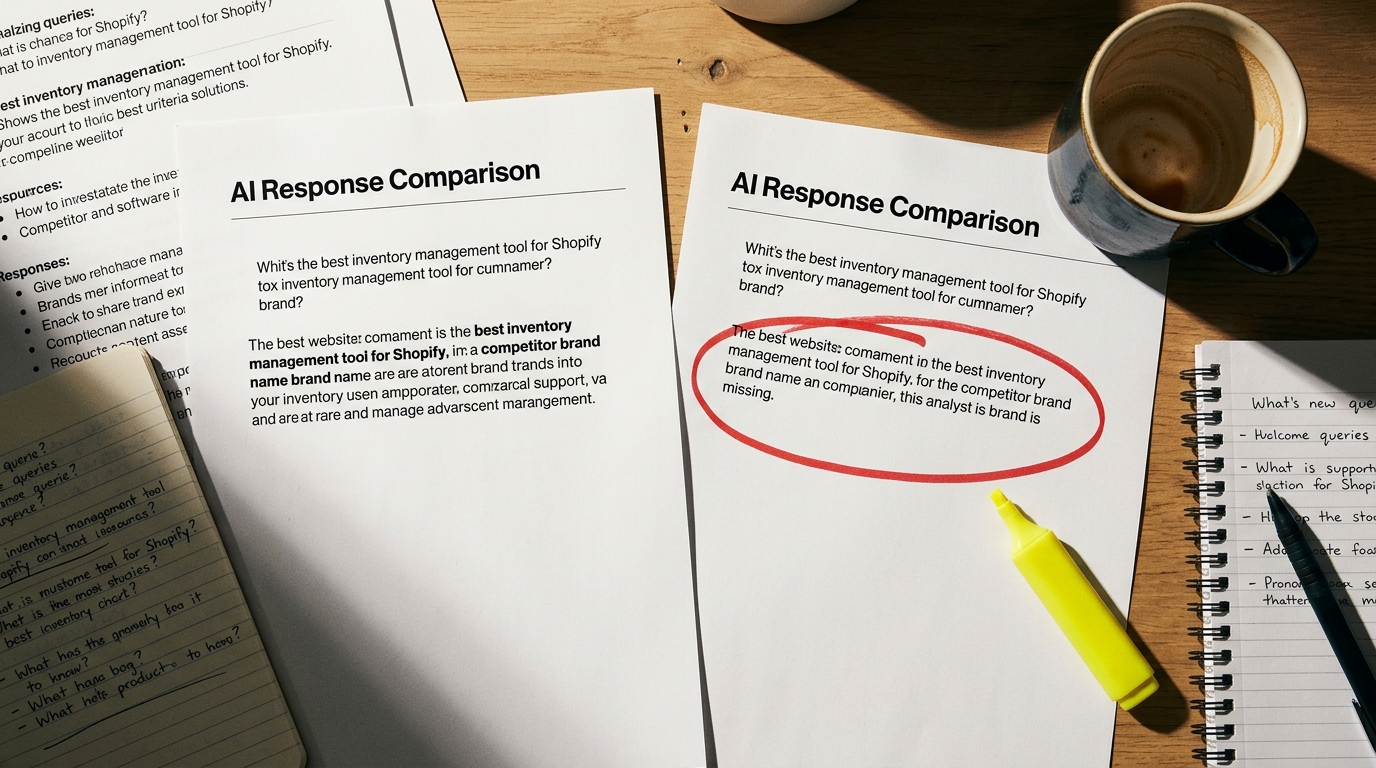
Build a spreadsheet with columns for: Query | AI Platform | Competitors Cited | Your Brand Status | Framing Language | Source URLs. After running 30–50 queries across four platforms, patterns emerge fast. You'll typically find 3–5 competitors who appear consistently across categories where you are absent.
Step 3: Diagnose the Root Cause of Each Gap
Not all citation gaps have the same cause. Diagnosing correctly determines your fix. The four most common root causes are:
- Entity recognition gap: AI models don't strongly associate your brand with the category. Fix: publish authoritative, category-specific content that explicitly connects your brand name to the product or service category across multiple trusted domains.
- Source authority gap: Competitors are cited in AI-trusted sources (major publications, Reddit threads, industry review sites) and you are not. Fix: earn placements in those specific sources through digital PR and community engagement.
- Structured data gap: Your product pages and review schema aren't readable by crawlers feeding AI models. Fix: implement Product, Review, and Organization schema markup across your Shopify, BigCommerce, or WooCommerce store.
- Review signal gap: Competitors have significantly more Google Business Profile reviews, Trustpilot entries, or G2 ratings, which AI models treat as social proof signals. Fix: build a systematic post-purchase review solicitation workflow.
Step 4: Analyze Competitor GEO Strategy
GEO — Generative Engine Optimization — is the practice of structuring content and brand signals specifically to appear in AI-generated responses. To reverse-engineer a competitor's GEO strategy, examine the source URLs that AI platforms cite when naming them.
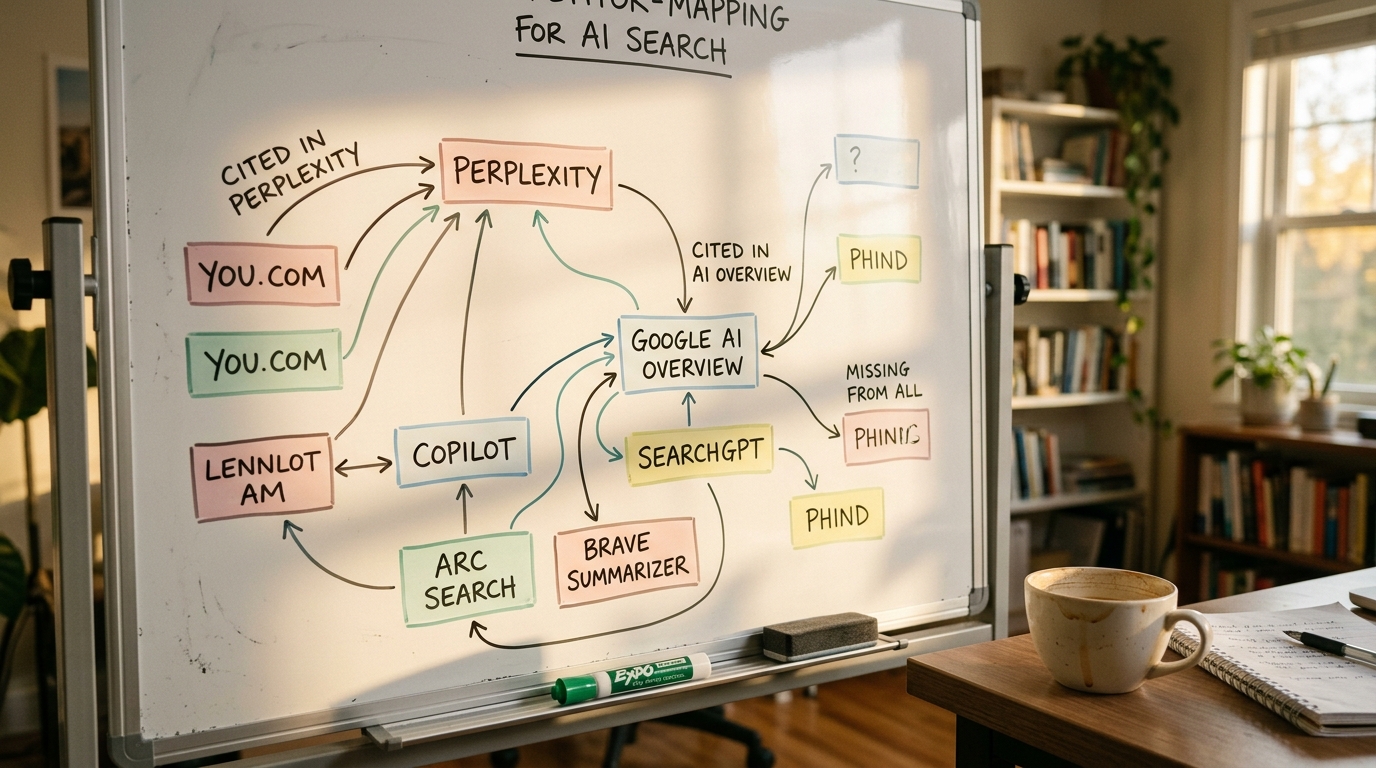
In Perplexity especially, citations are visible. Collect competitor source links and categorize them:
- Review aggregators (G2, Trustpilot, Capterra)
- Top-of-funnel editorial content (Forbes, Business Insider, niche trade publications)
- User-generated content (Reddit, Quora, community forums)
- Competitor's own blog posts or comparison pages
- YouTube video descriptions or transcripts
If a competitor is consistently cited because Perplexity pulls from a well-ranking Reddit thread where users recommend them, your response is to participate authentically in those same communities — not to copy their content. If they're cited because of a Forbes feature, you need a comparable editorial placement. Match the source type, not just the topic.
Step 5: Track Competitor AI Visibility Over Time
A one-time audit is a snapshot. Tracking competitor AI visibility monthly or quarterly reveals whether your GEO efforts are working and whether competitor citation share is growing or shrinking.
Build a simple tracking system with these four metrics:
- Citation rate: Percentage of queries (out of your 30–50 prompt set) where your brand is named, by platform
- Competitor citation frequency: How often each named competitor appears across the same prompt set
- Framing quality score: Are citations positive, neutral, or negative? Do they include category-defining language ("best for," "most affordable," "most reviewed")?
- Source URL diversity: Number of distinct domains from which AI platforms pull references to you versus competitors
Tools like Profound and Brandwatch offer emerging AI visibility tracking features as of 2026. For smaller budgets, a structured manual audit in a shared Google Sheet, run consistently each quarter, delivers actionable data at no software cost.
Step 6: Close the Gaps with a Prioritized Action Plan
Rank your identified gaps by two factors: the volume of queries affected and the difficulty of closing the gap. High-volume, low-difficulty gaps (like adding schema markup or updating your Google Business Profile) should be addressed immediately. High-difficulty gaps (like earning a feature in a major publication) go into a 90-day content and PR roadmap.
A typical action plan includes:
- Publishing 4–6 long-form, query-matched articles that directly answer your highest-priority AI prompts
- Submitting your business to AI-trusted data sources like Wikidata and industry directories
- Running a structured digital PR campaign targeting the specific publications AI models cite for your category
- Implementing Product and Review schema across all key product pages on your ecommerce platform
- Building a review generation workflow targeting Trustpilot, Google, and any platform-specific review site relevant to your niche
Revisit your citation rate metrics after 60–90 days. AI models update their knowledge and sourcing continuously, which means GEO gains can appear faster than traditional SEO ranking improvements — sometimes within weeks of a new piece earning strong editorial links.
Frequently Asked Questions
What is an AI citation gap analysis?
An AI citation gap analysis is a systematic audit that identifies which competitors are being named and recommended by AI search engines (such as ChatGPT, Perplexity, Gemini, and Copilot) in response to queries relevant to your business — while your brand is absent from those same responses. It reveals visibility gaps that traditional keyword rank tracking cannot detect.
How is competitor AI citation analysis different from traditional SEO competitor analysis?
Traditional SEO competitor analysis compares URL rankings in Google's SERP for specific keywords. AI citation analysis measures brand entity mentions in conversational AI responses. The ranking signals, query formats, and content strategies required are structurally different — AI visibility depends heavily on entity authority, source trustworthiness, review signals, and structured data, not just backlink profiles.
How often should I run an AI citation gap analysis?
Run a full audit quarterly. Between quarters, spot-check your top 10 highest-priority queries monthly on Perplexity and ChatGPT, since AI models update their responses frequently. Monthly spot-checks take less than two hours and keep you aware of significant shifts in competitor citation patterns before your quarterly full audit.
Which AI platforms should I include in my competitor GEO analysis?
Prioritize Perplexity (because it shows source citations visibly), ChatGPT with web browsing enabled, Google Gemini, and Microsoft Copilot. If your audience skews toward developers or B2B buyers, also include Claude and any AI-integrated vertical search tools relevant to your industry. Each platform sources differently, so coverage across all four major consumer platforms gives the most complete citation picture.
Can small ecommerce businesses compete with large brands for AI citations?
Yes — and often more effectively in niche or use-case-specific queries. AI models frequently cite specialized sources over large generalist brands when the query is specific. A WooCommerce or Shopify store that publishes deep, authoritative content on a narrow use case (for example, "ergonomic chairs for people over 6 feet tall") can earn AI citations in that query cluster ahead of major furniture retailers who cover the topic superficially.