Local Business Visibility in AI Search: What Small Business Owners Need to Know Right Now
AI-powered search tools — including Google's AI Overviews, ChatGPT search, Perplexity, and Microsoft Copilot — now answer millions of local queries directly, bypassing traditional blue-link results. To appear in these answers, your business needs structured, accurate, and citation-worthy information published across the web.
This shift is not theoretical. AI search features now appear on the majority of informational and local intent queries in Google Search. If your business information isn't structured correctly, you're invisible to the fastest-growing segment of search behavior in 2026.
Why AI Search Treats Local Businesses Differently
Traditional SEO rewarded businesses that ranked on page one. AI search works differently — it synthesizes information from multiple trusted sources and presents a single answer. That means the question is no longer "Can I rank #1?" but rather "Am I a source that AI engines trust and cite?"
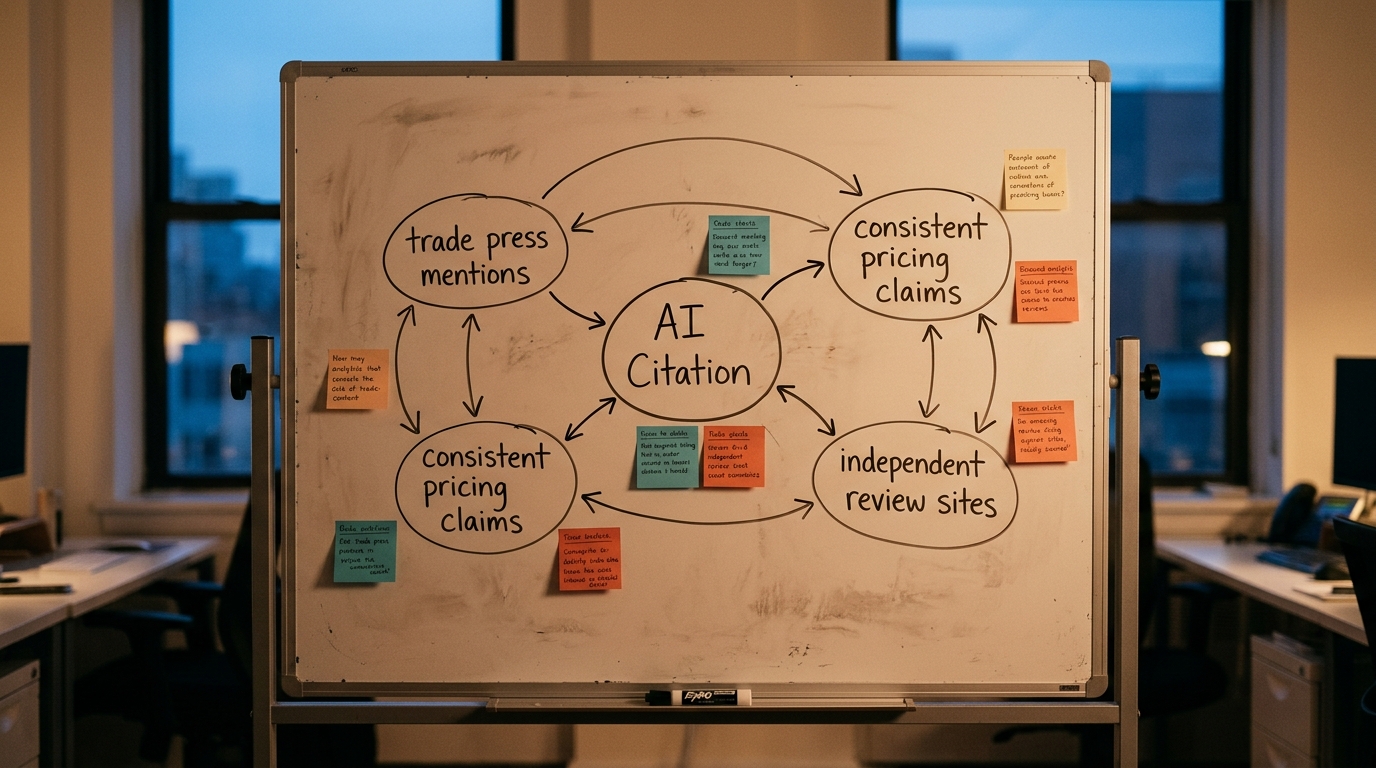
For local businesses, AI engines pull from four primary data layers:
- Google Business Profile data — hours, address, phone, category, reviews
- Structured website content — service pages, location pages, FAQs with schema markup
- Third-party citations — Yelp, Apple Maps, Bing Places, industry directories
- Review signals — volume, recency, and sentiment across platforms
If any of these layers contradict each other — for example, your website says you're open Sundays but your Google Business Profile says you're closed — AI systems flag the inconsistency and deprioritize your listing in favor of a more reliable source.
The 6 Signals That Determine Local AI Visibility
AI search engines evaluate local businesses on a specific set of signals. Here's how each one functions in 2026:
- NAP Consistency (Name, Address, Phone) — Your business name, address, and phone number must be identical across every platform. Even minor variations — "St." vs. "Street," or a missing suite number — create trust gaps that AI engines penalize.
- Google Business Profile completeness — Businesses with fully completed profiles, including a business description, product/service listings, attributes, and recent posts, are cited more frequently in AI Overviews than incomplete profiles.
- Review velocity and sentiment — AI engines use review data as a trust proxy. A business with 40 reviews averaging 4.7 stars over the past 6 months signals higher authority than one with 200 reviews and no new activity in two years.
- Schema markup on your website — LocalBusiness schema, FAQ schema, and Service schema tell AI crawlers exactly what your business does, where it operates, and who it serves. Without schema, AI systems have to guess — and they often guess wrong.
- Location-specific content — A single generic "Services" page ranks poorly for location-based AI queries. Dedicated pages targeting "[Service] in [City]" with original content dramatically improve citation probability.
- Authority of inbound citations — The more authoritative sites that reference your business (local news outlets, chambers of commerce, well-established directories), the higher the trust score AI engines assign to your data.
Google Business Profile: Still the Foundation
Your Google Business Profile remains the single highest-leverage asset for local AI visibility. In AI Overviews for local queries, Google's own structured data feeds are weighted more heavily than any third-party source.
Audit your profile against this checklist:
- Business name matches your signage and website exactly
- Primary category is the most specific available option
- Service areas are defined (not just a single address)
- All services and products are listed with descriptions
- Business description uses natural language, not keyword-stuffing
- At least 10 photos uploaded, with alt-text context where possible
- Q&A section has been seeded with your most common customer questions
- Posts are published at least twice per month
Your Website Is an AI Citation Source — Build It That Way
AI search engines treat your website as a primary source document. The structure and content of your site directly determine whether an AI engine quotes you or ignores you.
Three website changes with the highest impact on local AI visibility:
1. Add LocalBusiness Schema to Every Page
Schema markup is machine-readable code that explicitly tells AI crawlers your business name, address, phone, hours, geo-coordinates, and service types. Without it, AI engines extract this data imprecisely from your text — and extraction errors get your business cited with wrong information or not cited at all.
2. Build Dedicated Location and Service Pages
A plumber in Austin serving five neighborhoods should have five location pages — not one generic "Service Areas" page. Each page should include neighborhood-specific context, testimonials from customers in that area, and content that addresses the specific questions people in that area ask. AI engines favor specificity over generality.
3. Structure FAQs with FAQ Schema
FAQ sections on service pages, marked up with FAQ schema, are among the most commonly cited content types in AI Overviews. Write FAQs in plain question-and-answer format, answering the question in the first sentence. This post follows that format intentionally — AI engines are far more likely to extract structured Q&A content than buried paragraph answers.
AI Search vs. Traditional SEO: How Local Visibility Has Changed
Factor Traditional SEO (2022) AI Search Visibility (2026) Primary goal Rank in top 10 blue links Be cited in AI-generated answer Content format Long-form keyword-optimized articles Structured, factual, schema-marked content Review signals Supporting ranking factor Primary trust signal for local authority NAP consistency Important for local pack Critical — inconsistencies disqualify listings Location pages Nice to have Required for neighborhood-level AI visibility Schema markup Optional enhancement Baseline requirement for AI citationPractical First Steps for Small Business Owners
You don't need to overhaul your entire digital presence overnight. Prioritize these actions in order:
- Audit NAP consistency — Search your business name on Google Maps, Yelp, Apple Maps, and Bing Places. Fix every discrepancy before doing anything else.
- Complete your Google Business Profile — Score it against the checklist above. A fully complete profile takes less than two hours to build and delivers immediate impact.
- Add LocalBusiness schema to your website — Your web developer or platform (most major CMS platforms support schema plugins) can implement this in under an hour.
- Create or improve your service and location pages — Write at least one page per service-city combination you want to rank for. Make each page genuinely useful, not duplicated filler.
- Build a review generation system — Ask every satisfied customer for a Google review. A steady drip of recent positive reviews outperforms a large static review count.
If your website runs on a platform with an SEO foundation built in — and your provider offers add-on services for ongoing local SEO work — those tools become even more valuable as AI search continues to expand its share of how customers find local businesses.
What is AI search, and how is it different from regular Google results?
AI search uses large language models to synthesize information from multiple sources and deliver a single direct answer, rather than a list of links. Google's AI Overviews, ChatGPT search, and Perplexity are the leading examples. For local businesses, this means you need to be a trusted data source, not just a highly-ranked page.
Does my Google Business Profile still matter if AI is changing search?
Yes — Google Business Profile data is one of the primary inputs AI Overviews uses for local queries. A complete, accurate, and actively maintained profile is still the single highest-leverage asset for local AI visibility in 2026.
What is schema markup and does my small business website need it?
Schema markup is structured code added to your website that explicitly tells search engines and AI crawlers what your business is, what it does, where it's located, and who it serves. LocalBusiness, FAQ, and Service schema are the three most impactful types for small businesses. Without schema, AI systems extract your data imprecisely, leading to citation errors or omission.
How many Google reviews does a local business need to appear in AI search results?
There is no fixed minimum. Recency and consistency matter more than raw volume. A business receiving 3–5 new reviews per month with an average rating above 4.5 signals stronger authority to AI engines than a business with 300 old reviews and no recent activity.
Can I improve local AI visibility without rebuilding my website?
Yes. Completing your Google Business Profile, fixing NAP inconsistencies across directories, and building citations on authoritative sites can significantly improve AI visibility without any website changes. Adding schema markup is the one website-level change that delivers the highest return with the lowest effort, and most CMS platforms support it through plugins or built-in tools.