AI search competitor analysis means systematically tracking which brands get cited by generative AI engines, identifying the content and authority signals that earn those citations, and closing the gaps between your visibility and your competitors' in AI-native results. Traditional rank tracking is no longer sufficient: when ChatGPT, Perplexity, Google AI Overviews, and Microsoft Copilot answer a query directly, the competitor who earns a citation wins the impression, regardless of their classic SERP position.
This guide gives small business owners and digital marketers a repeatable framework to audit, monitor, and outmaneuver competitors inside AI-generated answers.
Why Classic SEO Competitive Analysis Falls Short in 2026
Legacy competitor analysis tools measure keyword rankings, backlink profiles, and domain authority. Those signals still matter, but they only partially explain AI citation behavior. A 2025 Semrush study found that 63% of URLs cited in AI Overviews ranked outside the top 5 organic positions for the same query. That gap reveals a new competitive surface that most small businesses are not yet tracking.
AI engines pull citations based on entity authority, topical depth, structured data quality, and how consistently a brand appears across trusted third-party sources. A competitor with a DA of 40 but a tightly structured FAQ schema and 50 consistent directory listings can out-cite a DA-70 rival in an AI-generated answer. Understanding that dynamic is the foundation of this framework.
Step 1: Build Your AI Citation Baseline
Before you can track competitors, you need your own citation baseline. Run 30–50 of your most commercially relevant queries through four platforms: ChatGPT (Plus or API), Perplexity, Google AI Overviews, and Microsoft Copilot. For each query, record:
- Which brands are named or linked in the answer
- Whether your brand appears at all
- The position of the citation (first mention, mid-answer, or closing recommendation)
- Whether the citation includes a live URL or is a textual reference only
Spreadsheet this data by query intent category: informational, navigational, commercial investigation, and transactional. You will immediately see which intent buckets your competitors dominate and which are genuinely open.
Step 2: Run a Competitor GEO (Generative Engine Optimization) Audit
Generative Engine Optimization, or GEO, is the practice of structuring content so AI systems extract and cite it accurately. Auditing a competitor's GEO strategy means reverse-engineering why their content gets cited. For each competitor who appears in your baseline queries, examine the following signals:
Competitor GEO vs. Traditional SEO: 6 Key Differences
| Signal | Traditional SEO Focus | GEO Focus (2026) |
|---|---|---|
| Content structure | H-tag hierarchy for crawlers | Question-and-answer blocks extractable as citations |
| Schema markup | Product, Article, LocalBusiness | FAQPage, HowTo, Speakable, Claim |
| Authority signal | Backlink count and DA | Named-entity consistency across Wikipedia, Wikidata, and G2 |
| Content length | Long-form for topical coverage | Concise, quotable paragraphs under 80 words per answer block |
| Citation target | Ranking page 1 | Appearing inside the AI-generated response |
| Measurement tool | Ahrefs, Semrush rank tracker | Profound, Otterly, custom prompt monitoring dashboards |
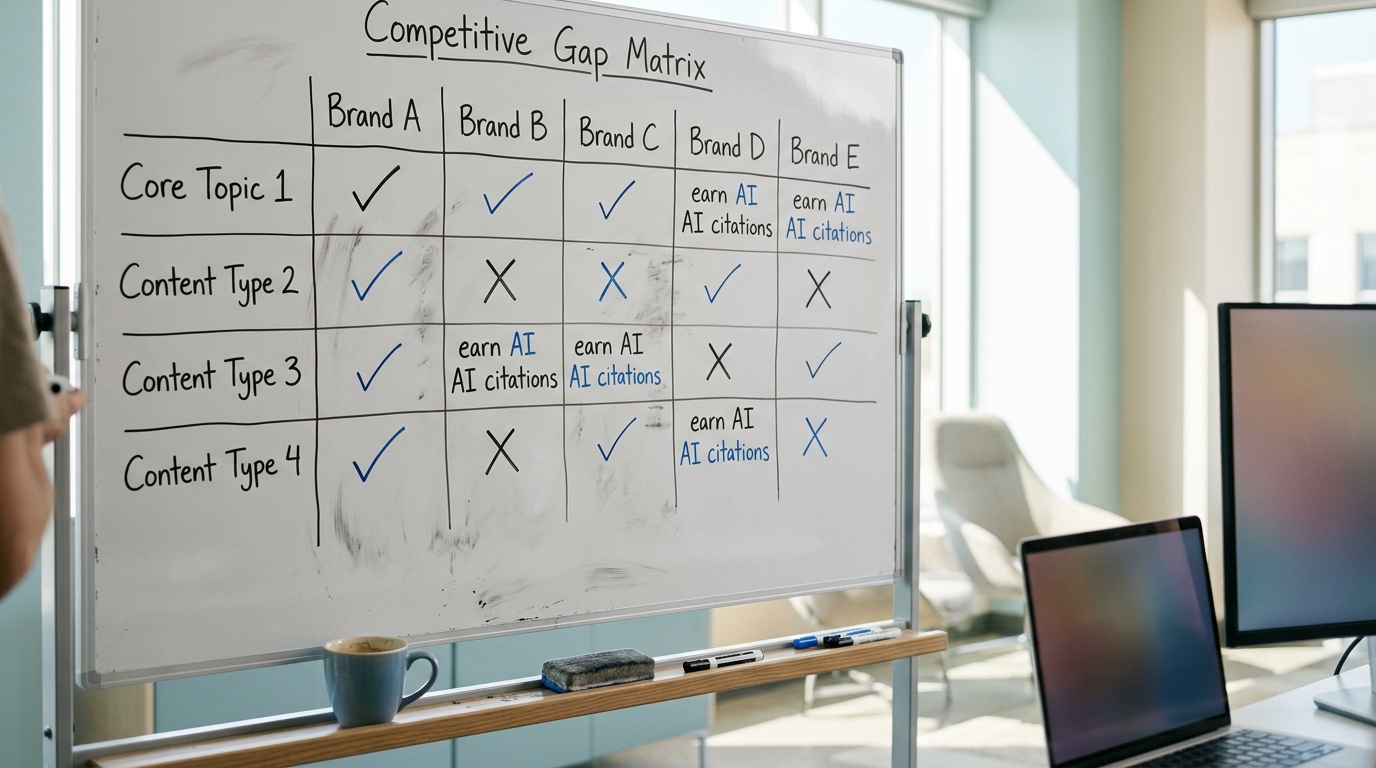
Step 3: Conduct an AI Citation Gap Analysis
An AI citation gap analysis identifies every query where a competitor is cited and you are not. Structure the analysis into three tiers:
- Tier 1: High-volume, high-intent gaps. These are commercial queries where a competitor is consistently cited and you are invisible. Prioritize these for immediate content and schema investment.
- Tier 2: Informational gaps that feed purchase journeys. AI engines frequently cite educational content before a buyer reaches a transactional query. A competitor who owns "how to choose a [product category]" answers will often carry that citation authority into bottom-funnel queries.
- Tier 3: Brand mention gaps. Queries where an AI names a competitor in comparison context ("X vs. Y") but excludes you entirely. These are entity awareness problems, not content problems. The fix is third-party coverage: press mentions, review platform profiles, and structured brand data.
Tools that surface citation gaps in 2026 include Profound (purpose-built for AI answer tracking), Otterly.ai, and BrandMentions' AI monitoring module. Each platform queries AI engines at scale and logs citation frequency by brand and topic.
Step 4: Track Competitor AI Visibility Over Time
Single-point audits go stale within weeks because AI engines update their retrieval behavior constantly. Build a repeatable monitoring cadence to track competitor AI visibility:
- Weekly: Run your 10 highest-priority queries through Perplexity and Google AI Overviews. Log competitor citations and any new URLs referenced.
- Monthly: Full 50-query audit across all four platforms. Update your citation gap spreadsheet and flag any competitor who gained or lost citation frequency by more than 15%.
- Quarterly: Pull competitor schema changes using Screaming Frog or Sitebulb. If a competitor suddenly starts dominating AI answers for a topic cluster, a schema update or a new content hub is almost always the cause.
Set Google Alerts and Mention.com alerts for each competitor's brand name combined with your category keywords. When a competitor earns a major press mention or a new Trustpilot or G2 profile, AI engines often begin citing them more frequently within 4–6 weeks.
Step 5: Close the Gaps with a GEO Content Sprint
Once you know exactly where competitors hold citation advantages, close the gap with targeted content actions:
- Rewrite existing pages to include a dedicated answer block: a 60–80 word paragraph that answers the target query directly, in the first 150 words of the page.
- Add FAQPage schema to every page targeting a question-based query. Google's Structured Data Testing Tool confirms implementation accuracy.
- Publish a comparison page for every "X vs. Y" query where a competitor is cited but you are not. AI engines cite comparison content heavily for commercial investigation queries.
- Build entity authority by creating or claiming profiles on Wikidata, Crunchbase, G2, Clutch, and industry-specific directories. Consistency of name, address, phone, and founding year across these sources strengthens how AI engines identify and trust your brand.
- Earn third-party citations through digital PR: a single mention in a Shopify blog post, a BigCommerce partner page, or a Wirecutter-style review site can unlock AI citation visibility faster than 10 new backlinks from mid-tier sites.
Measuring ROI on AI Search Competitor Analysis
Connect your citation tracking to business outcomes by measuring three metrics every month:
- AI Citation Share: Your brand citations divided by total citations across your tracked query set. A citation share increase of 5 percentage points typically corresponds to a measurable uplift in branded search volume within 60 days.
- AI-Referred Traffic: In Google Analytics 4, filter sessions by referrer domains including perplexity.ai, bing.com/chat, and any Copilot referral paths. Track week-over-week growth as a standalone channel.
- Conversion Rate from AI Referral Traffic: AI-referred visitors in 2026 convert at 2–3x the rate of organic search visitors for most ecommerce and service businesses, because they arrive with a specific recommendation already in mind. Tracking this separately justifies continued investment in GEO.
AI Search Competitor Analysis FAQ
What is AI citation gap analysis?
AI citation gap analysis is the process of identifying every query where a competitor brand receives a citation inside an AI-generated answer and your brand does not. It pinpoints specific content, schema, and authority deficits that prevent your business from appearing in generative search results.
How do I track competitor AI visibility without expensive enterprise tools?
Start by manually querying Perplexity and ChatGPT with your 20 most important commercial keywords weekly, logging results in a spreadsheet. For scaling, Otterly.ai offers entry-level plans under $100 per month that automate prompt monitoring across multiple AI engines and track competitor citation frequency over time.
Which AI engines should I prioritize for competitor analysis?
Prioritize Google AI Overviews first because it sits inside Google Search and reaches the largest commercial audience. Perplexity ranks second for purchase-intent queries. ChatGPT matters most for B2B and technical categories. Microsoft Copilot is critical if your audience is Windows-native enterprise users. Monitor all four, but weight your sprint effort toward Google AI Overviews for most small business categories.
How long does it take to close a competitor AI citation gap?
Schema and answer-block content updates typically show citation impact within 4–8 weeks. Entity authority improvements, such as building out Wikidata profiles and earning third-party press coverage, take 8–16 weeks to influence AI citation behavior. Comparison page content often earns citations within 3–4 weeks because AI engines prioritize that format for commercial investigation queries.
Does traditional backlink building still help with AI citation visibility?
Yes, but the relationship is indirect. Backlinks from authoritative domains increase the likelihood that AI training and retrieval systems recognize your domain as trustworthy. However, the direct drivers of AI citations are answer-block content quality, FAQPage and HowTo schema, and cross-platform entity consistency. Allocate at least 60% of your effort to those three levers before investing additional budget in link acquisition for AI citation goals specifically.