AI ad intelligence tools now let small business owners reverse-engineer competitor paid media strategies in hours, not weeks - extracting spend estimates, messaging patterns, creative formats, and channel mix from publicly observable ad data without needing insider access.
If you're running Google Ads, Meta campaigns, or any paid media in 2026, you're competing against businesses that are already using AI to study your ads. The playing field has shifted: the question is no longer whether to use AI PPC competitor analysis, but how to do it systematically without blowing your research budget.
This guide breaks down exactly how to use AI for competitor ad creative analysis- from the tools worth using to the specific signals worth tracking.
Why Manual Competitor Ad Research Doesn't Work Anymore
Manually checking Facebook Ad Library, Google Ads Transparency Center, and SimilarWeb once a month gives you a snapshot. AI gives you a motion picture. Competitors often rotate 15–30 ad variants per week across channels, adjust messaging based on real-time performance signals, and test entirely new value propositions within 72-hour cycles. No human analyst can track that volume across multiple competitors simultaneously.
The case for automation is straightforward:
- Volume: AI tools can monitor hundreds of competitor ads daily across Google, Meta, TikTok, YouTube, and display networks.
- Pattern recognition: Machine learning identifies messaging shifts and creative trends weeks before they become obvious to human observers.
- Predictive signals: Spend velocity and creative iteration frequency can indicate a competitor is preparing a product launch or seasonal push before it hits the market.
The Four Layers of AI Competitor Ad Intelligence
Effective competitor ad creative analysis operates across four distinct layers. Most small businesses only scratch the surface of Layer 1.
Layer 1: Creative Inventory and Format Mapping
This is what most people think of when they hear "competitor ad research" - collecting all visible ads a competitor is running. AI tools like Semrush Advertising Research, Pathmatics (now part of Sensor Tower), and BigSpy automate this collection. The AI doesn't just aggregate; it categorizes by format (static image, video, carousel, responsive), platform, and landing page destination. In 2026, this layer is table stakes.
Layer 2: Messaging and Copy Analysis
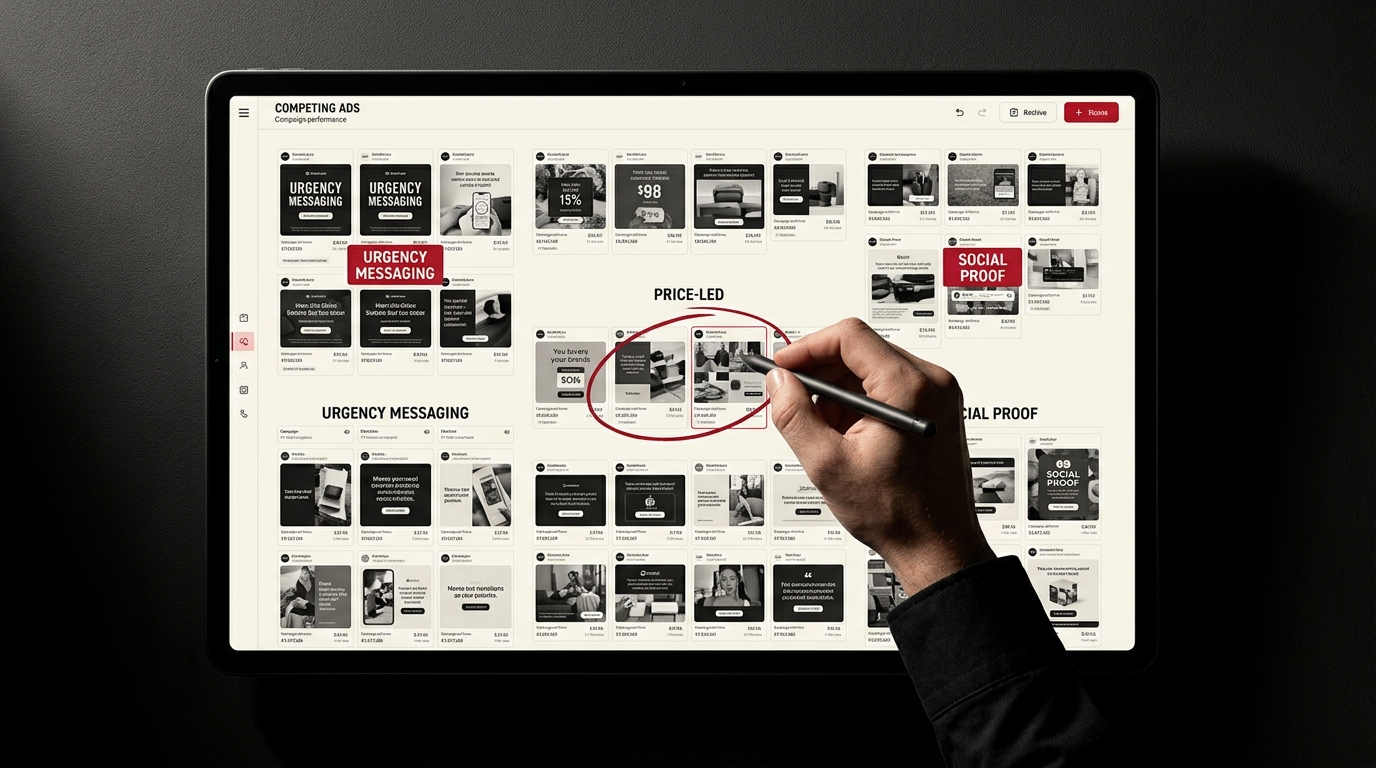
This is where AI earns its budget. Natural language processing (NLP) models analyze headline structures, CTA language, emotional triggers, and value proposition framing across a competitor's entire ad library. For example, if a competitor's top-spending ads all lead with price anchoring ("Starting at $X") rather than benefit-led copy, that's a deliberate strategic signal - and AI can surface it in seconds. Tools like Foreplay.co and custom GPT-4o prompting workflows are increasingly used by mid-market teams for this purpose.
Layer 3: Spend Allocation and Channel Mix Estimation
No tool gives you exact competitor ad spend - but AI-powered predictive ad analysis uses impression volume, creative refresh rate, and audience targeting breadth to estimate relative budget allocation. If a competitor suddenly launches 12 new video variants for YouTube while reducing static image ads on Meta, the AI flags a channel pivot before you'd notice it manually. Semrush and SpyFu both offer spend estimation models trained on historical auction data.
Layer 4: Performance Signal Inference
The most advanced layer. AI infers which ads are performing based on longevity (ads running longer are usually profitable), engagement proxy signals (shares, comments on Meta), and landing page consistency (high-performing ads typically direct to focused, optimized landing pages). A competitor running the same creative for 45+ days is a strong signal that ad is converting. An ad pulled after 3 days almost certainly wasn't.
AI Ad Intelligence Tools: A Comparison for Small Business Owners
Tool Best For Platforms Covered AI Feature Depth Price Range Semrush Advertising Research Google Ads copy + keyword overlap Google Search, Display Moderate - spend estimates, ad history $$ Meta Ad Library + AI Prompting Social creative research on a budget Meta (Facebook/Instagram) Low native AI, but GPT workflows add depth Free + LLM cost BigSpy Multi-platform creative research Meta, TikTok, YouTube, Google Moderate - filters by engagement, run time $ Sensor Tower (Pathmatics) Enterprise spend intelligence Cross-platform including CTV High - spend models, creative tagging $$$$ Foreplay.co Creative team research and swipe files Meta, TikTok High for creative analysis workflows $$A Practical Workflow for Small Business Owners
You don't need an enterprise budget to run a meaningful AI PPC competitor analysis process. Here's a repeatable four-step workflow that works for businesses spending $2,000–$20,000/month on paid media:
- Identify your top 5 direct ad competitors. Use Google's Auction Insights report and Semrush to confirm which businesses are bidding on the same keywords. Don't assume your SEO competitors are your PPC competitors - they're often different.
- Pull a 90-day creative snapshot. Use BigSpy or Meta Ad Library to collect all active and recently expired ads for each competitor. Export to a shared folder or Foreplay board.
- Run NLP analysis on headlines and body copy. Paste competitor ad copy into a structured GPT-4o prompt that asks for: primary value proposition, dominant emotional trigger (fear, aspiration, urgency, social proof), CTA type, and price strategy. Do this across all collected ads and tag each ad in a spreadsheet.
- Identify the longevity leaders. Flag any ad that has been running for 30+ days. These are your highest-priority creative references - the market has validated them. Reverse-engineer the structure (hook → proof point → CTA) and identify what your own ads are missing.
What to Actually Do With Competitor Creative Intelligence
Collecting data is worthless without action. Here's how to translate competitor ad creative analysis into concrete improvements:
- Find the messaging gap. If every competitor leads with price, lead with transformation or outcome. Differentiation in ad copy is as important as product differentiation.
- Steal proven structures, not content. If a competitor's top-performing ad uses a 3-second problem statement followed by a before/after visual, test that structure with your own creative. Format theft is legal and smart.
- Anticipate competitive seasonal pushes. If a competitor launches 8 new ads in early October every year, they're preparing for a Q4 promotion. Get your Q4 creative live first.
- Kill underperforming angles faster. When your competitor tests and quickly pulls a specific messaging angle, that's a signal the market rejected it. Don't test the same dead end.
The Predictive Layer: What AI Can Tell You About What's Coming
Predictive ad analysis is the frontier of competitive intelligence in 2026. Advanced platforms now use creative velocity (how fast a brand is producing new variants), audience expansion signals, and landing page iteration patterns to predict competitive moves 2–4 weeks out. For small business owners, the most accessible version of this is simple: track how many new ads a competitor launches each week. A sudden spike - say, jumping from 3 new ads per week to 18 - almost always precedes a major campaign, product launch, or sale event.
Set up a weekly monitoring cadence. Even a 30-minute Friday review of competitor ad libraries, filtered by "newly added this week," gives you an early warning system that most small businesses don't have.
Ai Ad Intelligence FAQ
What is AI ad intelligence and how is it different from traditional competitor research?
AI ad intelligence uses machine learning and NLP to automatically collect, categorize, and analyze competitor ads at scale - across multiple platforms simultaneously. Traditional competitor research involves manually checking ad libraries and recording observations in spreadsheets. AI tools process hundreds of ads in minutes, identify messaging patterns, and flag performance signals that no human analyst could detect at the same speed or volume.
Can small businesses afford AI PPC competitor analysis tools?
Yes. The most accessible workflow combines free tools (Meta Ad Library, Google Ads Transparency Center) with a $20–$30/month LLM subscription for NLP analysis, plus an optional tool like BigSpy at the entry tier. A meaningful competitor intelligence process is achievable for under $100/month. Enterprise platforms like Sensor Tower are built for brands spending $100K+/month on media.
How accurate are AI spend estimates for competitor ads?
Spend estimates from tools like Semrush and SpyFu are directional, not exact. They're trained on impression proxy data and historical auction signals, so they're useful for understanding relative investment (e.g., "Competitor A spends roughly 3x more on Google than Competitor B") but not for precise dollar figures. Treat them as confidence signals, not financial data.
How often should I run competitor ad creative analysis?
For businesses spending under $10K/month on paid media, a weekly 30-minute review of newly launched competitor ads plus a deeper monthly analysis is sufficient. For brands in fast-moving categories like DTC ecommerce, fast fashion, or SaaS, a twice-weekly review cadence is more appropriate. The key metric to watch isn't ad count - it's creative refresh velocity and longevity of specific ads.
Is using competitor ad data for inspiration legal and ethical?
Analyzing publicly visible ads is entirely legal - ad libraries are intentionally public. Copying competitor creative verbatim (images, copy, trademarked elements) is not. The ethical and legal standard is clear: study structure, strategy, and messaging angles freely, but produce original creative. Reverse-engineering why an ad works is competitive intelligence; reproducing it wholesale is infringement.