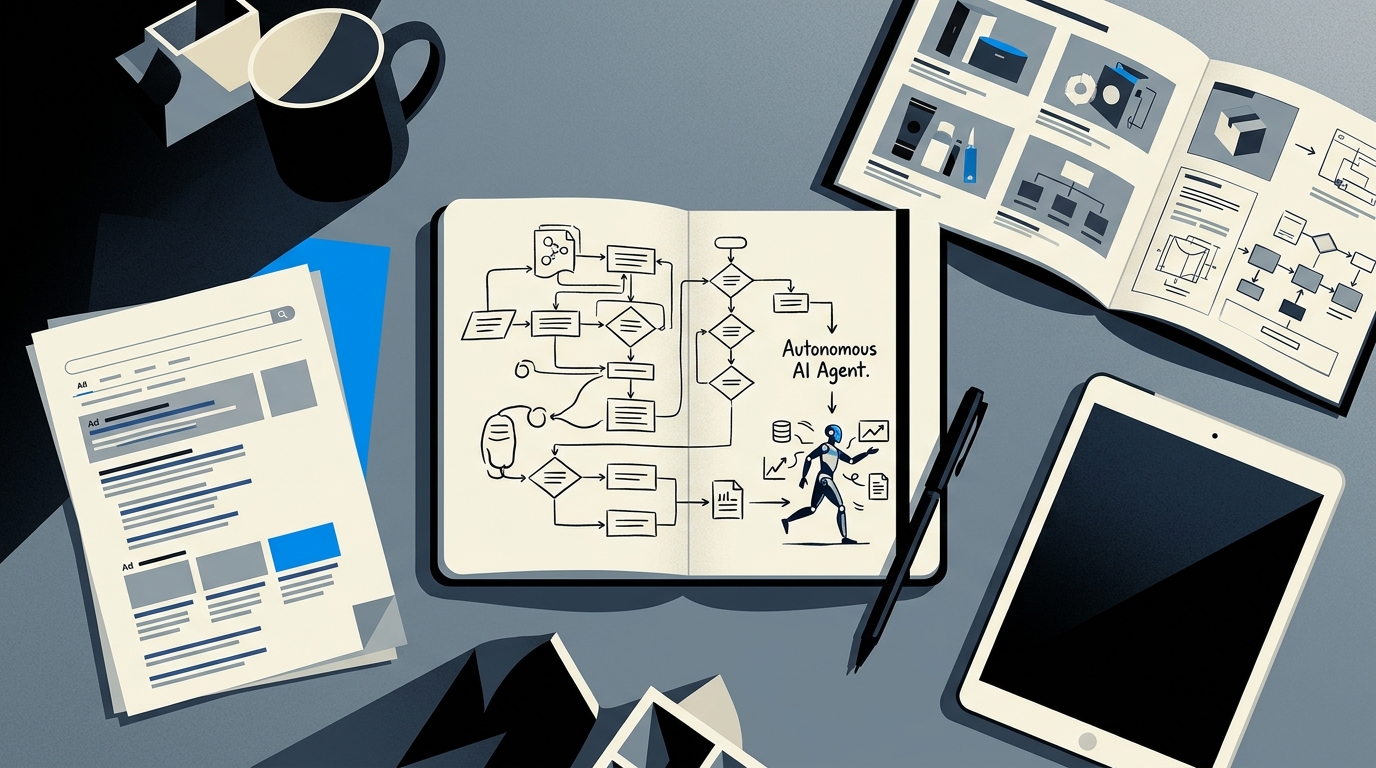
To build a content production engine with AI agents, you must first define clear objectives for your marketing channels, then select specialized AI tools for each stage of the workflow—from keyword research to content creation, optimization, and distribution. This structured approach transforms content marketing from a manual process into a scalable, automated system.
The Rise of AI Agents in Marketing: Moving Beyond Single Prompts
In 2026, the conversation around AI in digital marketing has shifted dramatically. We've moved past simple one-off tasks using tools like ChatGPT and are now building sophisticated, interconnected systems of AI agents. Think of it like hiring a team of digital specialists: one agent is your SEO strategist, another is your copywriter, a third is your ad campaign manager, and a fourth is your social media coordinator. These agents work together, passing information and tasks between them to execute complex marketing strategies with minimal human oversight.
An AI agent is an autonomous system designed to perceive its environment, make decisions, and take actions to achieve specific goals. Unlike a simple chatbot, an agent can perform multi-step tasks, learn from feedback, and operate continuously. For a small business owner, this means you can automate entire workflows that once consumed hours of your time, from generating a month's worth of blog posts to optimizing PPC campaigns in real-time.
A 4-Step Framework for Your AI Content Engine
Building an automated content engine isn't about finding one magical "do-it-all" AI. It's about strategically linking specialized tools into a cohesive workflow. Here’s how to build your own.
Step 1: Define Your Strategic Objectives and KPIs
Before you touch any software, define what success looks like. Your goals will determine which agents you need and how you configure them.
- Goal: Increase organic traffic by 20% in the next quarter.
- Required AI Functions: SEO keyword research, competitor analysis, topic clustering, long-form content generation, on-page SEO optimization.
- KPIs: Keyword rankings, organic sessions, backlink velocity.
- Goal: Generate 50 qualified leads per month from Google Ads.
- Required AI Functions: Audience research, ad copy generation, bid management, performance monitoring, landing page A/B testing.
- KPIs: Click-through rate (CTR), conversion rate, cost per acquisition (CPA).
Step 2: Select Your "Team" of Specialized AI Agents
No single AI excels at everything. The key is to assemble a "stack" of specialized tools that handle specific parts of the content lifecycle. Your 2026 AI marketing stack could look something like this:
- The Strategist (SEO & Ideation): This agent identifies opportunities. It analyzes SERPs, finds low-competition keywords, and generates content briefs based on top-ranking competitors.
- Tools: SurferSEO's AI Outline Builder, Semrush's Topic Research tool, MarketMuse's content planning features.
- The Writer (Content Generation): This agent takes the brief from the Strategist and produces a draft. Modern generative AI is adept at creating structured, factually-grounded articles when given a detailed outline.
- Tools: Jasper AI's long-form assistant, Writer.com for brand-aligned copy, Claude 3 for nuanced and creative writing.
- The Optimizer (SEO & Editing): This agent refines the draft. It checks for SEO alignment, readability, and brand voice consistency. It might also suggest internal links or optimize meta descriptions.
- Tools: Clearscope for content grading, Grammarly for grammar and tone, SurferSEO's Content Editor.
- The Distributor (Publishing & Promotion): This agent takes the final content and gets it in front of your audience. This can involve scheduling posts, creating social media snippets, or even generating email newsletters.
- Tools: Buffer's AI Assistant for social captions, Beehiiv for AI-powered email creation, Zapier to connect your CMS to your social channels automatically.
Step 3: Build and Automate the Workflow
This is where you connect your agents. The goal is to create a "digital assembly line" where the output of one agent becomes the input for the next. Automation platforms are crucial here.
A typical SEO content workflow might look like this:
- Trigger: You add a target keyword to a Google Sheet.
- Action 1 (Strategist): An automation tool like Zapier or Make.com sends the keyword to SurferSEO's API, which generates a detailed content brief and saves it to a Google Drive folder.
- Action 2 (Writer): The same automation detects the new brief, sends it to the Jasper API, and generates a draft article. The draft is saved back to the Google Drive folder.
- Action 3 (Human Review): You receive a notification in Slack or email to review and edit the draft. This human-in-the-loop step is critical for quality control, fact-checking, and adding unique brand insights.
- Action 4 (Optimizer): After your approval, the draft is automatically loaded into Clearscope for a final SEO score check.
- Action 5 (Distributor): Once the article achieves a target score (e.g., A++), the automation pushes it as a draft to your Shopify, BigCommerce, or WooCommerce blog for final publishing.
Step 4: Monitor, Analyze, and Refine
Your AI content engine is not a "set it and forget it" system. Performance data is the fuel for improvement. Use AI-powered analytics tools to track your KPIs.
- SEO Performance: Use tools that track keyword rankings and attribute traffic to specific articles. Did the content generated for "handmade leather wallets" actually rank and drive sales?
- Ad Performance: For PPC, use an ad management AI like AdCreative.ai or Omneky to monitor which creative and copy combinations have the lowest CPA. The system can then automatically allocate more budget to winners and pause losers. A 2025 study by the Performance Marketing Association noted that AI-managed campaigns saw an average 15% reduction in CPA compared to manually managed ones.
- Iterate: If a certain type of content isn't performing, feed that data back to your "Strategist" agent. You might need to adjust your keyword criteria, content brief templates, or the prompts you use for your "Writer" agent.
AI Agent Use Cases: SEO vs. PPC Management
The structure of your AI engine will differ based on the marketing channel. Here’s a comparison of how to apply this framework to SEO and PPC.
AI Engine Smackdown: SEO vs. PPC
Workflow Stage SEO Automation with AI PPC Automation with AI 1. Research & Strategy Agent identifies keyword clusters, analyzes SERP intent, and generates topic briefs. Agent analyzes audience demographics, identifies competitor bidding strategies, and suggests campaign structures. 2. Content Creation Agent writes long-form blog posts, product descriptions, and FAQ pages based on briefs. Agent generates hundreds of ad copy variations (headlines, descriptions) and image/video creatives. 3. Optimization Agent scores content against top competitors, suggests internal links, and optimizes meta tags. Agent A/B tests ad creatives in real-time, adjusts bids based on performance, and reallocates budget. 4. Distribution Agent schedules posts to the CMS and generates social media snippets to promote the new content. Agent pushes winning ad combinations directly to Google Ads or Meta Ads platforms. 5. Key Tools SurferSEO, Clearscope, Jasper AI, Zapier. AdCreative.ai, Omneky, Google Performance Max, Anyword.By implementing a structured AI content engine, you transform your marketing from a series of disjointed, manual tasks into a predictable, scalable system. This allows you, the business owner, to focus on high-level strategy while your AI agents handle the day-to-day execution, giving you a powerful competitive advantage in 2026 and beyond.
Frequently Asked Questions
What is an AI agent in the context of marketing?
An AI marketing agent is an autonomous software program designed to perform specific, multi-step marketing tasks without direct human command for each action. For example, an SEO agent can be tasked with "improving rankings for a keyword" and will then independently research competitors, generate a content brief, commission a draft from another AI, and optimize it for publishing.
Can I fully automate my content marketing with AI?
You can automate about 80-90% of the content production workflow, but a "human-in-the-loop" approach remains essential for success in 2026. Human oversight is critical for strategic direction, final editing, fact-checking, and injecting unique brand personality that AI cannot fully replicate. The goal is to automate the repetitive tasks, not eliminate human strategy.
How much does it cost to build an AI content engine?
The cost can range from $200 to over $1,000 per month, depending on the tools you choose. A basic stack might include subscriptions to an SEO tool like SurferSEO (~$100/mo), a generative AI writer like Jasper AI (~$100/mo), and an automation platform like Zapier (~$50/mo). More advanced engines incorporating video generation or programmatic ad management tools will have higher costs.