An AI marketing stack combines specialized AI tools and autonomous agents to automate tasks across SEO, content creation, advertising, and customer service, aiming to handle up to 80% of routine marketing workflows. This integration allows marketing teams to focus on strategy and high-level execution rather than repetitive manual work.
The Shift from AI Tools to AI Agents in Marketing
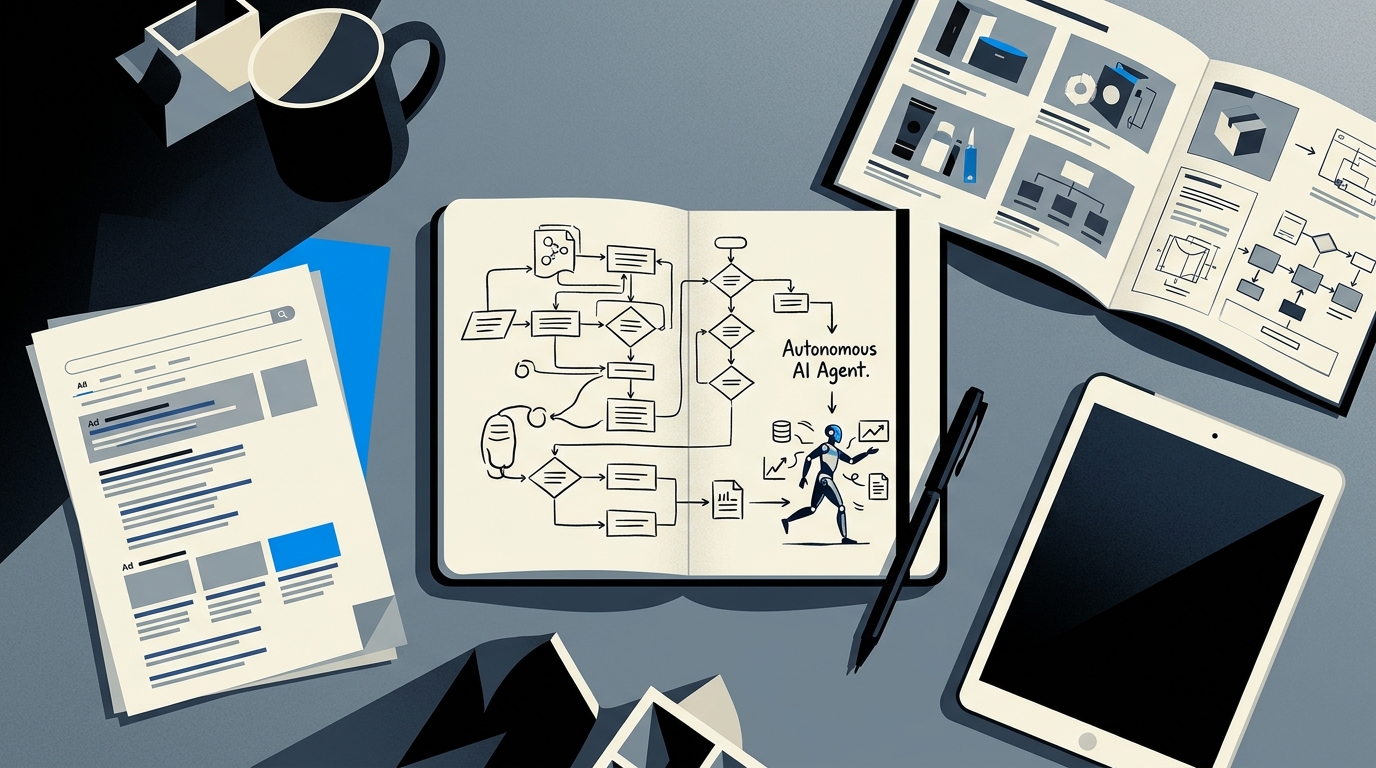
For years, marketers have used AI-powered tools for specific tasks—writing ad copy, generating images, or analyzing keyword data. While useful, these tools required constant human input and management. The major shift in 2026 is the rise of autonomous AI agents. These are not just tools; they are systems designed to execute multi-step workflows with a defined goal and minimal human intervention.
Think of it this way:
- An AI Tool (2024): You ask Jasper to write a blog post outline. You review it, send it to Surfer SEO for optimization, then manually create a social media post about it.
- An AI Agent (2026): You give an agent the goal: "Increase organic traffic for the 'summer dog toys' keyword cluster." The agent researches keywords, analyzes SERPs, generates an SEO-optimized article, creates five social media variations with relevant images, and schedules them for posting. It then monitors performance and suggests follow-up content based on initial engagement data.
Building an effective 2026 marketing stack means combining these powerful autonomous agents with best-in-class specialized AI tools to create a semi-automated marketing engine for your business.
The 7 Essential Tools for Your 2026 AI Marketing Stack
A truly effective stack doesn't rely on one "do-it-all" platform. Instead, it integrates specialized tools that excel at their specific functions. Here are the seven key components to automate the majority of your marketing efforts.
1. SEO & Content Strategy: MarketMind AI
Primary Function: Autonomous SEO strategy and competitive analysis.
Gone are the days of manually pulling keyword reports and analyzing competitor backlinks. MarketMind AI acts as your team's autonomous SEO strategist. You connect it to your Google Search Console and competitors' domains, and it continuously monitors the landscape. It identifies content gaps, tracks SERP volatility, and generates complete content briefs based on ranking opportunities. Its "Opportunity Score" feature, updated in its Q1 2026 release, now predicts the likelihood of ranking within 90 days with 85% accuracy, according to their internal studies.
2. Content Generation & Optimization: Writer (with Persona Sync)
Primary Function: Brand-aligned, multi-format content creation.
Writer has evolved far beyond a simple text generator. Its key feature in 2026 is "Persona Sync," which allows you to upload your brand style guides, customer personas, and even transcripts of past sales calls. The AI then generates content—from blog posts to email newsletters—that is perfectly aligned with your voice, tone, and target audience's pain points. It integrates directly with MarketMind AI briefs and your Shopify or BigCommerce product catalog to create SEO-optimized product descriptions and category pages automatically.
3. Ad Management & Optimization: AdGenius Quantum
Primary Function: Cross-platform PPC campaign management.
Manually tweaking bids and A/B testing ad creative is an inefficient use of time. AdGenius Quantum is an AI agent that manages your Google Ads, Meta Ads (Facebook & Instagram), and TikTok campaigns from a single dashboard. You set the budget, target ROAS (Return on Ad Spend), and primary conversion goals. The agent handles:
- Budget Allocation: Dynamically shifts spend between platforms based on real-time performance.
- Creative Generation: Uses generative AI to create and test dozens of image, video, and copy variations.
- Bid Management: Executes predictive bidding strategies based on conversion probability, a feature that has improved client ROAS by an average of 22% since its introduction in late 2025.
4. Social Media & Community Management: CommuniBot
Primary Function: Automated social scheduling and first-line community engagement.
CommuniBot is the AI agent that runs your social calendar. It pulls from approved content generated by Writer, adapts it for each platform's format (e.g., creating a short video script for TikTok from a blog post), and schedules it based on optimal engagement times. More importantly, it handles first-line comment responses. It can answer common product questions, acknowledge positive feedback, and flag complex or negative comments for human review, effectively handling over 70% of inbound social interactions.
5. Customer Support & Personalization: AgentZero
Primary Function: AI-powered customer service and website personalization.
Your website's chatbot should be more than a glorified FAQ page. AgentZero is a customer service AI that integrates with your Shopify, BigCommerce, or WooCommerce backend. It can handle complex queries like "Where is my order?" or "Do you have this shirt in blue in a size medium?" It can also process returns and exchanges directly within the chat window. Its personalization engine modifies your website's homepage and product recommendations in real-time based on a user's browsing history, moving beyond simple "customers also bought" widgets.
6. Creative Asset Generation: Midjourney v8.1 & Runway Gen-4
Primary Function: High-fidelity image and video creation.
While platforms like AdGenius have built-in creative tools, you still need best-in-class generators for hero images, campaign assets, and custom videos.
- Midjourney v8.1 (released January 2026): The leader in photorealistic and stylistic image generation. Its "Style Persistence" feature allows you to train it on your brand's aesthetic for consistent visual output.
- Runway Gen-4: The go-to for text-to-video and video-to-video generation. Perfect for creating short-form video ads for social media or dynamic product showcases without a film crew.
7. The Central Hub: Zapier Central
Primary Function: AI workflow automation and integration.
Zapier Central is the glue that holds your entire AI stack together. It's an AI-powered automation platform that lets you build complex, cross-app workflows in plain English. For example, you can create a "Zap" that says: "When MarketMind AI identifies a new keyword opportunity with a score above 80, create a brief, send it to Writer to generate a draft, and create a task in Asana for my marketing manager to review it." It allows your specialized tools to communicate and act as a single, cohesive system.
Framework for Integrating Your AI Marketing Stack
- Map Your Manual Workflows: Identify the most time-consuming, repetitive tasks your team performs daily (e.g., daily ad budget checks, writing social media posts, responding to basic customer emails).
- Start with One Function: Don't try to automate everything at once. Pick one area, like PPC management, and implement a tool like AdGenius Quantum. Master it and measure its impact.
- Build an Integration Pathway: Use Zapier Central to connect your first tool to your existing systems. For example, have AdGenius send a daily performance summary to your team's Slack channel.
- Layer in the Next Function: Once advertising is semi-automated, move to content. Integrate MarketMind AI and Writer, and use Zapier to connect them to your ad platform (e.g., automatically create an ad campaign for every new blog post published).
- Review and Refine: Set a quarterly review to assess your stack. Is it saving time? Is performance improving? Are there new tools that could replace or enhance a component of your stack?
By 2026, the question is no longer "Should we use AI in marketing?" but "How effectively are we automating our workflows with an integrated AI stack?" Building this system gives small businesses the leverage to compete with much larger teams, turning marketing from a cost center into a highly efficient growth engine.
What is an autonomous AI marketing agent?
An autonomous AI marketing agent is a system designed to perform complex, multi-step marketing tasks with a specific goal and minimal human oversight. Unlike a simple AI tool that performs one function (like writing copy), an agent can manage an entire workflow, such as researching, writing, publishing, and analyzing a blog post for SEO.
How much does it cost to build an AI marketing stack?
Costs vary, but a foundational stack for a small business in 2026 typically ranges from $500 to $2,000 per month. This includes subscriptions for several specialized tools like Writer, AdGenius Quantum, and Zapier Central. The investment is offset by significant savings in labor hours and increased marketing efficiency and ROI.
Can AI completely replace my marketing team?
No, AI is a force multiplier, not a replacement. The goal of an AI marketing stack is to automate the 80% of routine, data-driven, and repetitive work. This frees up your human team to focus on the 20% that requires strategic thinking, brand building, creative direction, and complex problem-solving—tasks where human oversight remains critical.
Which eCommerce platforms integrate best with these AI tools?
Shopify, BigCommerce, and WooCommerce have the most robust API ecosystems in 2026, making them ideal for integration. Tools like Writer, AgentZero, and AdGenius Quantum offer direct, native integrations for these platforms, allowing them to pull product data, customer information, and order history to personalize marketing and support efforts.