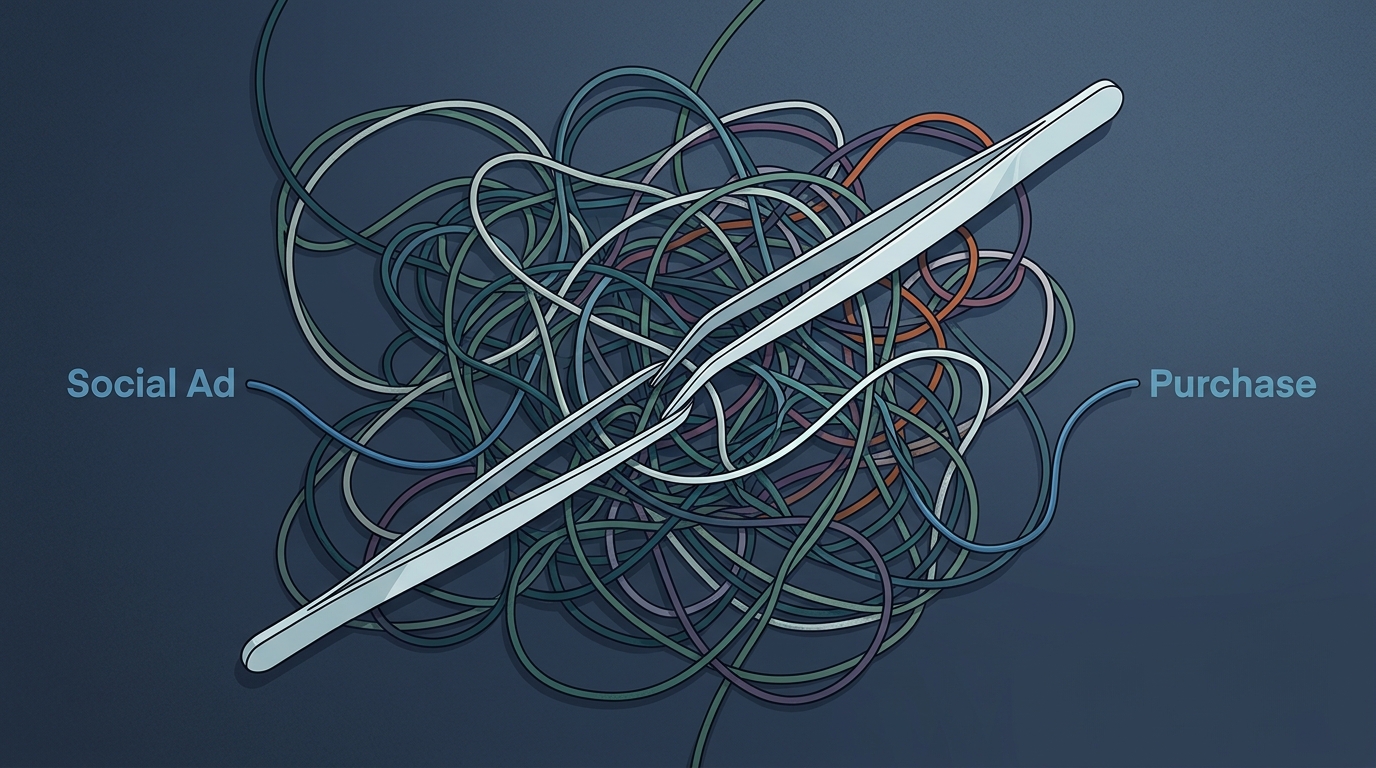
What Are Marketing Attribution Models?
Marketing attribution models are frameworks used to assign credit to the marketing touchpoints a customer interacts with on their journey to conversion. For small business owners, choosing the right model is critical for understanding which digital marketing efforts—from SEO and PPC to social media—are actually driving sales and how to allocate your budget effectively. This is especially true in 2026, where over 70% of Google searches are now "zero-click," meaning the user gets their answer directly on the search results page without visiting a website.
The rise of zero-click search, where a customer might see your business name, address, or product price in a Google rich snippet and convert later without ever clicking, makes traditional "last-click" attribution obsolete. If you only measure the final click, you miss the crucial brand discovery and consideration stages that happen on the search engine results page (SERP) itself.
Why Traditional Attribution Fails in the Age of Zero-Click Search
For years, the default attribution model for many businesses was Last-Click Attribution. This model gives 100% of the credit for a sale to the very last touchpoint a customer engaged with. For example, if a customer clicks a Google Shopping ad and buys, that ad gets all the credit.
This model is simple but dangerously misleading in 2026. Consider this common B2B marketing scenario:
- A potential client sees your company's name in a "Local Pack" map result while searching for "commercial plumbing services near me." They don't click, but they learn your name. (This is a zero-click touchpoint).
- A week later, they see a targeted LinkedIn ad from your company.
- They then search for your brand name directly, click the organic search result, and fill out a contact form.
With last-click attribution, the "branded organic search" gets 100% of the credit. This ignores the initial discovery on Google Maps and the brand reinforcement from the LinkedIn ad. You might mistakenly conclude that SEO is your only effective channel and cut your social media budget, thereby starving the top of your sales funnel.
Comparing Popular Marketing Attribution Models
To get a more accurate picture of what's working, businesses must adopt more sophisticated attribution models. Each model offers a different perspective on the customer journey.
Single-Touch Attribution Models
- First-Touch Attribution: Gives 100% of the credit to the first touchpoint. In our example, the Google Maps Local Pack view would get all the credit. This model is useful for understanding top-of-funnel channels that drive initial awareness.
- Last-Touch Attribution: Gives 100% of the credit to the last touchpoint. As discussed, this model is overly simplistic and often misrepresents the customer journey by overvaluing bottom-of-funnel channels.
Multi-Touch Attribution Models
Multi-touch models distribute credit across multiple touchpoints, providing a more holistic view of your marketing performance.
Model How it Works Best For Linear Distributes credit equally across all touchpoints in the journey. Businesses with long sales cycles where every touchpoint is considered equally important for nurturing leads. Time-Decay Gives more credit to touchpoints that occurred closer in time to the conversion. Short promotional campaigns or B2C ecommerce where recent interactions have more influence. U-Shaped (Position-Based) Assigns 40% of the credit to the first touchpoint, 40% to the last, and divides the remaining 20% among the middle touchpoints. Companies that highly value both lead generation (first touch) and closing channels (last touch). Data-Driven Attribution (DDA) Uses machine learning to analyze all converting and non-converting paths, assigning credit based on each touchpoint's actual contribution to the conversion. Businesses with sufficient conversion data (e.g., Google Ads requires at least 300 conversions in 30 days) looking for the most accurate model.Implementing a Modern Attribution Strategy
Moving beyond clicks requires combining quantitative data with qualitative insights. Here’s a framework for small business owners.
1. Choose Your Primary Attribution Model
For most ecommerce businesses on platforms like Shopify or WooCommerce, a U-Shaped or Time-Decay model is a great starting point. They balance the importance of initial discovery with the actions that close the sale. For B2B marketing with longer sales cycles, a Linear model can provide a balanced view of the entire nurturing process. If you have the data volume, transitioning to Data-Driven Attribution in tools like Google Analytics 4 is the gold standard for accuracy.
2. Measure Brand Discovery and Zero-Click Impressions
Since you can't rely on website clicks alone, you must track proxies for brand awareness. This is where tools like Google Search Console become invaluable.
- Track Brand Impression Growth: Monitor the total number of impressions for your brand name in Google Search Console. A steady increase indicates your top-of-funnel efforts (like SEO for non-branded terms or social ads) are successfully building brand recognition.
- Analyze SERP Feature Performance: Use Search Console's "Search Appearance" report to see how often you appear in Rich Results, Local Packs, or People Also Ask boxes. These impressions are powerful zero-click touchpoints. An increase in impressions for these features is a key performance indicator (KPI).
- Correlate Impressions with Branded Search Volume: Look for patterns. Did a spike in non-branded impressions from a new blog post lead to an increase in branded searches and direct traffic two weeks later? This correlation demonstrates the impact of your top-of-funnel content.
3. Leverage Post-Purchase Surveys
The simplest way to understand the customer journey is to ask the customer. Implement a simple, one-question survey on your order confirmation page: "How did you first hear about us?"
This qualitative data helps fill the gaps left by attribution software. If customers frequently select "Google search" or "A friend's recommendation," it reinforces the value of your SEO and customer service efforts that digital models might miss.
The Future is Algorithmic
As privacy regulations evolve and third-party cookies are fully deprecated, algorithmic models like Data-Driven Attribution will become the norm. These models rely on first-party data and AI to model conversions that can no longer be directly observed. For Shopify and BigCommerce store owners, this means ensuring your analytics and ad platform integrations (like the Google & YouTube app) are correctly configured to pass back rich conversion data. The more high-quality data your platforms have, the more accurately they can attribute success across your entire marketing mix, including those all-important zero-click discoveries.
What is the best attribution model for a small business?
For a small business just starting, a U-Shaped (Position-Based) model is often best. It gives deserved credit to both the first touchpoint that introduced a customer to your brand and the last touchpoint that sealed the deal, which reflects a common customer journey. It's a significant improvement over last-click without the data requirements of a data-driven model.
How does zero-click search affect B2B marketing attribution?
Zero-click search heavily impacts B2B marketing because consideration phases are long and often begin with informational queries. A potential client might see your business in a Google Local Pack or featured snippet, learn your name, and not "click" for weeks or months. B2B marketers must track brand search volume and SERP feature impressions in Google Search Console as key metrics to measure this initial, unclicked discovery phase.
Can I use Data-Driven Attribution on my Shopify store?
Yes. As of 2026, Data-Driven Attribution (DDA) is the default model for all new conversion actions in Google Ads and is the primary model in Google Analytics 4 (GA4). By integrating your Shopify store with GA4 and Google Ads, and ensuring you meet the minimum data thresholds (typically around 300 conversions and 3,000 ad clicks in 30 days), you can leverage DDA to get a more accurate, AI-powered view of your marketing performance.